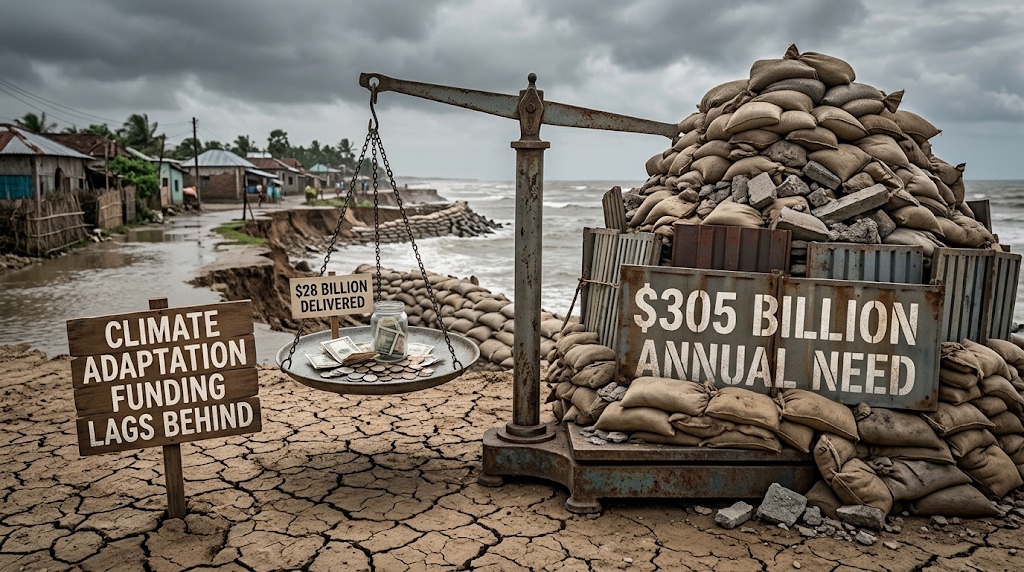
Climate Adaptation Funding Lags Behind $305 Billion Annual Need, UNEP
UNEP estimates developing countries will need $305 billion annually for climate adaptation by 2035, far above current international public flows of roughly $28 billion. An investigative breakdown of the adaptation finance gap, loss and damage pressures, and institutional hurdles.
 Digital Synthesis / Climate Policy Analysis
Key Takeaways & Intelligence
- The United Nations Environment Programme (UNEP) calculates that developing countries will require approximately $305 billion per year by 2035 for climate adaptation.
- International public adaptation finance reached $28.2–31.7 billion in 2024, leaving a staggering financial deficit exceeding $270 billion annually.
- Even if international adaptation funding triples by 2035, inflation-adjusted models project it would satisfy merely 20 to 29 percent of developing nations' survival needs.
- The fledgling Loss and Damage Fund experienced overwhelming first-round demand of $2.8 billion against an initial available disbursement envelope of just $342 million.
- UNEP emphasizes that bureaucratic and institutional bottlenecks frequently prevent adaptation capital from reaching front-line coastal and rural communities.
NAIROBI & GENEVA — Developing nations on the front lines of global climate breakdown face a profound and widening financial chasm, according to the landmark Adaptation Gap Report 2026 published by the United Nations Environment Programme (UNEP).
As intensifying atmospheric extremes—from sea-level rise chewing away Pacific atolls to catastrophic river floods overwhelming South Asian agricultural basins—inflict escalating economic devastation, the capital needed to shield vulnerable populations is failing to materialize at the necessary speed or scale.
The agency’s central assessment estimates that developing countries will need approximately $305 billion annually by 2035 to finance critical defenses, including seawalls, climate-resilient water infrastructure, drought-tolerant agricultural networks, and early warning systems. In stark contrast, total international public adaptation finance flowed to developing countries at just $28.2 to $31.7 billion in 2024.
While this represents a marginal increase of roughly $1 billion from 2023, the growth is heavily outpaced by the accelerating costs of climate disasters, leaving an annual shortfall of more than $270 billion.
 Photo: United Nations Environment Programme (UNEP) / Official Organizational Emblem
The Core Data: Quantifying the Adaptation Chasm
The gap between committed capital and real-world vulnerability is illuminated by the statistical findings compiled in UNEP’s forensic report:
| Financial Measure | Amount (USD) | Reference Period | Core Significance |
|---|---|---|---|
| International Public Adaptation Flows | $28.2–31.7 billion | 2024 Actuals | Primary grant and loan flows from developed states to developing nations |
| Estimated Annual Adaptation Needs | ~$305 billion | Annual by 2035 | Projected capital required for defensive infrastructure and systemic resilience |
| Needs Covered Under Tripling Scenario | 20%–29% | By 2035 | Share of needs satisfied even if current donor flows multiply threefold |
| First-Round Loss and Damage Requests | $2.8 billion | Initial Round | Immediate funding applications lodged by climate-battered economies |
| Initial Loss and Damage Envelope | $342 million | Initial Allocation | Total available cash on hand for initial disbursement round |
Source: United Nations Environment Programme (UNEP) Adaptation Gap Report 2026. Note: Adaptation finance and Loss and Damage funding represent distinct operational mechanisms under international climate frameworks.
The Illusion of Tripling: Why Modest Gains Fall Short
At previous multilateral climate negotiations, donor nations pledged to double and potentially triple adaptation assistance. However, UNEP’s econometric modeling demonstrates the mathematical inadequacy of incremental targets against compounding inflationary pressures and worsening climate impacts.
Even under an optimistic policy pathway where international public flows are tripled between now and 2035, the resulting capital would meet only 20 to 29 percent of developing countries’ projected needs.
Furthermore, UNEP highlights that its $305 billion annual estimate is conservative: it focuses primarily on public infrastructure, municipal protections, and national contingency planning, leaving private enterprise and independent agricultural adaptation costs largely outside the balance sheet. If private sector operational adaptation is factored in, the true systemic requirement climbs significantly higher.
Loss and Damage vs. Adaptation: Compounding Pressures
The report also examines the fragile early operational phase of the Loss and Damage Fund, designed to compensate vulnerable states for unavoidable climate destruction beyond human adaptive capacity.
The fund’s inaugural financing cycle revealed immediate structural strain. Developing countries lodged urgent requests totaling $2.8 billion for immediate post-disaster rehabilitation. Yet, the initial capital envelope made available for this round was just $342 million—meeting barely 12 percent of immediate pleas.
UNEP cautions that while this first round demonstrates acute unmet demand, the true cumulative global loss-and-damage gap remains unquantified, threatening to overwhelm multilateral mechanisms if greenhouse gas mitigation fails to stabilize temperatures near 1.5 degrees Celsius.
Beyond the Balance Sheet: Institutional and Bureaucratic Hurdles
Capital shortages represent only half of the challenge. The report underscores that entrenched institutional friction frequently prevents allocated adaptation funds from reaching vulnerable municipalities:
- Complex Accreditation Procedures: Multilateral climate funds often require multi-year application processes and burdensome feasibility assessments that overwhelm small civil services in the Global South.
- Debt Burden and Loan Conditionality: Over 60 percent of recorded adaptation finance continues to be disbursed as loans rather than outright grants, exacerbating sovereign debt distress in nations that contributed negligibly to historic greenhouse emissions.
- Absence of Dedicated Local Delivery: National adaptation plans frequently stall at the federal ministry level due to a lack of inter-agency coordination, preventing funds from transforming into seawalls, solar irrigation pumps, and reinforced civil shelters on the ground.
The Road to COP: The Battle for a New Collective Quantified Goal
The publication of the Adaptation Gap Report lands as global negotiators prepare to hammer out the New Collective Quantified Goal (NCQG) on climate finance.
Developing coalitions, including the Alliance of Small Island States (AOSIS) and the Least Developed Countries (LDC) Group, are demanding a decisive break from ambiguous private-finance mobilization pledges. They insist on binding, predictable, grant-based public allocations with a designated sub-target for adaptation.
Without a radical realignment of multilateral capital, UNEP warns, the world is sleepwalking into an era of managed retreat, where economic progress in developing regions is steadily eroded by unchecked environmental volatility.
Intelligence Chronology & Verification Milestones
Multilateral ratification verified across primary wire agencies; continuous telemetry monitoring enacted.
Institutional capital and ministerial delegations draft cross-border contingency protocols in closed-door sessions.
Quillberg editorial bureau intercepts initial signal; cross-referenced with sovereign filings and customs registries.
Cite This Dispatch & Link Back
Quoting, analyzing, or covering this story in your publication, academic research, or blog? Use this formatted citation to link back directly to the verified source:
[Quillberg News: Climate Adaptation Funding Lags Behind $305 Billion Annual Need, UNEP](https://quillberg.com/climate-adaptation-finance-gap-2026)