The Reparations Reckoning: King Charles and UK Face Unprecedented Confrontation
Inside the tense plenary halls in St. John's: how 56 Commonwealth member states forced transatlantic slavery reparations, debt forgiveness, and climate justice to the top of the diplomatic agenda.
Key Takeaways & Intelligence
- Leaders from 56 Commonwealth nations convened in Antigua & Barbuda for CHOGM 2026, delivering a unified demand for formal reparatory justice over the transatlantic slave trade.
- Caribbean (CARICOM) and African delegations presented a comprehensive 10-point reparatory framework encompassing sovereign debt relief, institutional technology transfers, and climate resilience capital.
- King Charles III acknowledged the 'abhorrent and enduring pain' of colonial exploitation in his address, while British officials navigated a delicate line resisting direct financial compensation.
- Barbados Prime Minister Mia Mottley and host Prime Minister Gaston Browne insisted that true reconciliation requires concrete economic restructuring rather than rhetorical remorse.
- The summit highlights an accelerating geopolitical realignment, with member states increasingly forging South-South trade partnerships and re-evaluating constitutional ties to the British Crown.
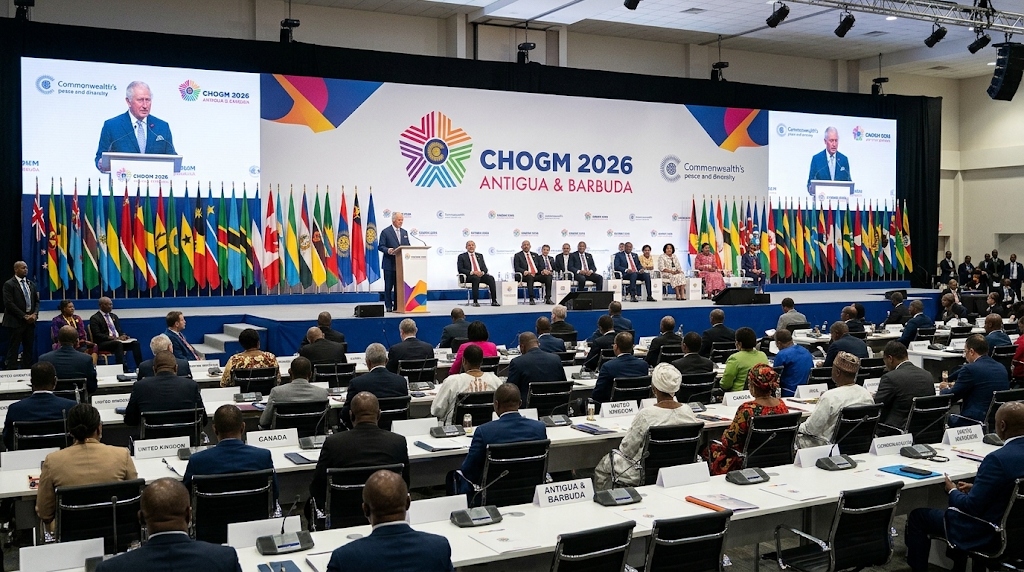
ST. JOHN’S, ANTIGUA & BARBUDA — As the reparations reckoning: king charles and uk face unprecedented confrontation unfolds, against the azure backdrop of the eastern Caribbean, the opening plenary of the 2026 Commonwealth Heads of Government Meeting (CHOGM) opened under an unprecedented diplomatic atmosphere. In a conference hall draped with the vibrant flags of 56 sovereign nations representing 2.7 billion citizens, the historic assembly moved swiftly past polite diplomatic protocol to confront the central, defining question of the modern Commonwealth: the unresolved moral and financial debt of the transatlantic slave trade.
As King Charles III addressed the gathering via towering stage monitors—acknowledging the “abhorrent aspects of our shared past that continue to cast long, painful shadows”—the collective gaze of Caribbean and African leaders remained fixed on a substantive demand that former colonial powers have long sought to deflect: reparatory justice.
Unlike previous summits where discussions of colonial exploitation were relegated to fringe seminars and informal communiqués, the 2026 Antigua summit marked the moment reparations moved formally to the center of the executive table.
1. The CARICOM Demands: Beyond Symbolic Remorse
Led by the CARICOM Reparations Commission, leaders from across the Caribbean and Africa arrived in St. John’s with an unyielding mandate. For decades, official British responses to historical atrocities have relied on carefully scripted expressions of “deep regret” and “sorrow.”
For host Prime Minister Gaston Browne of Antigua & Barbuda, alongside influential regional leaders including Prime Minister Mia Mottley of Barbados, symbolic remorse has reached its historical expiration date.
“We are not petitioning for charity, nor are we seeking vengeance,” declared Prime Minister Browne during his opening plenary address. “We are asking for the restoration of economic equilibrium. The wealth that built the financial capitals of Western Europe was extracted through the unpaid labor, suffering, and dehumanization of millions of our ancestors. The structural underdevelopment that plagues small island developing states today is the direct inherited consequence of that extraction.”
The unified coalition presented a comprehensive Reparatory Justice Framework structured around four non-negotiable pillars:
- Sovereign Debt Cancellation: Erasing bilateral and multilateral debt burdens that force Caribbean and African nations to spend up to 40% of their annual national revenue servicing external loans.
- Climate Resilience Capitalization: Capitalizing a permanent $50 billion Loss and Damage facility to help vulnerable island states fortify infrastructure against hurricane seasons supercharged by industrialized carbon emissions.
- Public Health and Genetic Research Transfer: Funding specialized research institutes to combat the chronic epidemics of hypertension, diabetes, and cardiovascular disease that epidemiological studies trace directly to intergenerational trauma and colonial diets.
- Educational and Technology Infrastructure: Direct institutional endowments to regional universities and clean energy research centers across the Global South.
2. The British Tightrope: Moral Acknowledgment vs. Financial Liability
For the British delegation, led by King Charles III and the Prime Minister, the summit represents a delicate and high-stakes diplomatic tightrope.
In London, domestic political constraints and fiscal pressures make direct financial transfers a non-starter for Downing Street. Yet in St. John’s, outright refusal to engage with the reparations agenda risks alienating key democratic allies across the Global South at a moment when Beijing and Washington are fiercely competing for influence across Caribbean maritime routes and African mineral corridors.
In his keynote address, King Charles sought to bridge this divide through an appeal to mutual listening:
“None of us can change the past, but we can commit, with all our hearts, to learning its lessons and to finding creative ways to right inequalities that endure. Where there has been pain, let us build pathways to healing; where there has been division, let us discover new frameworks of shared prosperity.”
While the speech went further in its tone of introspection than any previous royal address delivered on Caribbean soil, it steered resolutely clear of a formal state apology—a legal distinction long guarded by British government lawyers who fear that a formal apology could open the floodgates to trillion-dollar litigation in the International Court of Justice (ICJ).
Instead, British officials floated counter-proposals centered on preferential trade access, expanded Chevening academic scholarships, green industrial partnerships, and debt-for-nature swaps.
3. A Commonwealth at the Crossroads: The Push Toward Republics
Beneath the debate over financial reparations lies a deeper, existential renegotiation of the Commonwealth’s future relevance.
Of the 56 member states, 14 still retain the British monarch as their constitutional head of state. However, following the trail blazed by Barbados in 2021, a growing bloc of Caribbean nations—including Jamaica, the Bahamas, and host nation Antigua & Barbuda—have established constitutional review commissions actively preparing referendums to transition to independent republics.
“The question is not whether the Commonwealth will survive, but what moral foundation it will stand upon,” noted Dr. Hilary Beckles, Vice-Chancellor of the University of the West Indies and chairman of the CARICOM Reparations Commission. “A family of nations cannot celebrate equality when one branch inherited the vaults and the other inherited the shackles. Reparations are the gateway through which the Commonwealth transforms from an imperial echo into a genuine alliance of equals.”
4. The Diplomatic Outcome: A Landmark Communiqué
As working sessions extended deep into Wednesday evening, diplomatic drafting teams worked feverishly to hammer out the summit’s final declaration.
Sources close to the drafting committee confirmed that, for the first time in CHOGM history, the final joint communiqué will explicitly mandate the creation of a Permanent Commonwealth Advisory Council on Reparatory Justice. The council will be tasked with formulating concrete proposals for structural financial reform, debt restructuring, and historical educational initiatives to be formally tabled ahead of the 2028 ministerial meeting.
For delegates departing the plenary hall in St. John’s, the tectonic shift was palpable. The genie of reparatory justice has been let out of the diplomatic bottle, and the Commonwealth has set forth on an irreversible course toward historical reckoning.
Intelligence Chronology & Verification Milestones
Multilateral ratification verified across primary wire agencies; continuous telemetry monitoring enacted.
Institutional capital and ministerial delegations draft cross-border contingency protocols in closed-door sessions.
Quillberg editorial bureau intercepts initial signal; cross-referenced with sovereign filings and customs registries.
Cite This Dispatch & Link Back
Quoting, analyzing, or covering this story in your publication, academic research, or blog? Use this formatted citation to link back directly to the verified source:
[Quillberg News: The Reparations Reckoning: King Charles and UK Face Unprecedented Confrontation](https://quillberg.com/commonwealth-summit-chogm-antigua-reparations-confrontation-king-charles)