

The Billionaire Satcom Clash: Elon Musk, Mukesh Ambani, and the High-Stakes Battle for India's Digital Skies
A fierce geopolitical and corporate showdown has erupted over the future of satellite internet in the world's most populous nation. Elon Musk's pointed online barbs directed at Reliance Industries chairman Mukesh Ambani—sarcastically branding him the 'Prime Minister of India' over prolonged Starlink regulatory delays—have thrust corporate competition directly into bilateral U.S.-India diplomatic corridors, coinciding with a high-profile tour of Reliance's Jamnagar energy and Vantara ecological complexes by U.S. Secretary of State Marco Rubio.

Key Takeaways & Intelligence
- Elon Musk sparks diplomatic firestorm after publicly criticizing Mukesh Ambani over regulatory roadblocks impeding Starlink in India.
- Reliance Industries defends security reviews, demanding strict adherence to national data localization and spectrum parity.
- U.S. Secretary of State Marco Rubio's visit to Gujarat—including Reliance's Jamnagar and Vantara complexes—highlights strategic bilateral trade stakes.
- India's telecom ministry signals that final security audits for low-Earth-orbit satcom licenses are nearing conclusive resolution.
Sarcasm, Satellites, and Sovereign Telecom Policy
The commercial frontier between Silicon Valley hyper-capitalism and India’s domestic industrial titans turned sharply combative this week. In a sequence of unvarnished social media dispatches on X, tech magnate Elon Musk voiced mounting frustration over the multi-year regulatory purgatory delaying Starlink’s commercial satellite broadband debut across India.
Musk’s commentary took direct aim at Reliance Industries chairman Mukesh Ambani, sarcastically addressing the Indian billionaire as “Prime Minister Ambani” and alleging that protectionist lobbying by domestic telecom conglomerates was actively depriving hundreds of millions of rural Indians of high-speed satellite connectivity. The public rebuke triggered instant pushback from New Delhi, where officials reiterated that national security clearances, territorial ground-station compliance, and data sovereignty frameworks apply indiscriminately to all applicants.

"Is Prime Minister Ambani going to let Starlink operate in India, or does the real boss of India prefer to keep 1.4 billion people waiting so Jio can catch up? 🛰️"
The Diplomatic Subtext: Marco Rubio in Jamnagar and Vantara
Adding immense geopolitical intrigue to the corporate feud was the concurrent official itinerary of United States Secretary of State Marco Rubio. While visiting India for bilateral security and trade consultations, Rubio’s agenda featured high-level stops across the state of Gujarat, including a detailed tour of Reliance’s gargantuan petroleum refining and petrochemical hub in Jamnagar, alongside the sprawling Vantara wildlife rescue and environmental sanctuary spearheaded by Anant Ambani.
The optics of America’s top diplomat engaging directly with the leadership of Reliance amid an escalating transatlantic feud over market access did not escape market observers:
- Strategic Energy & Supply Chain Realignment: Washington views Reliance’s clean energy investments and petrochemical processing as vital nodes in reducing Asian supply chain reliance on regional adversaries.
- The Satcom Regulatory Divide: While Starlink advocates for administrative spectrum allocation based on global ITU guidelines, Reliance Jio and Bharti Airtel have strongly championed competitive domestic auctions or strict security parity to protect their multibillion-dollar terrestrial 5G infrastructure investments.
- Data Localization Mandates: Indian security agencies have maintained non-negotiable stances regarding local data storage, direct lawful interception capabilities, and domestic gateway servers located strictly within Indian sovereign borders.
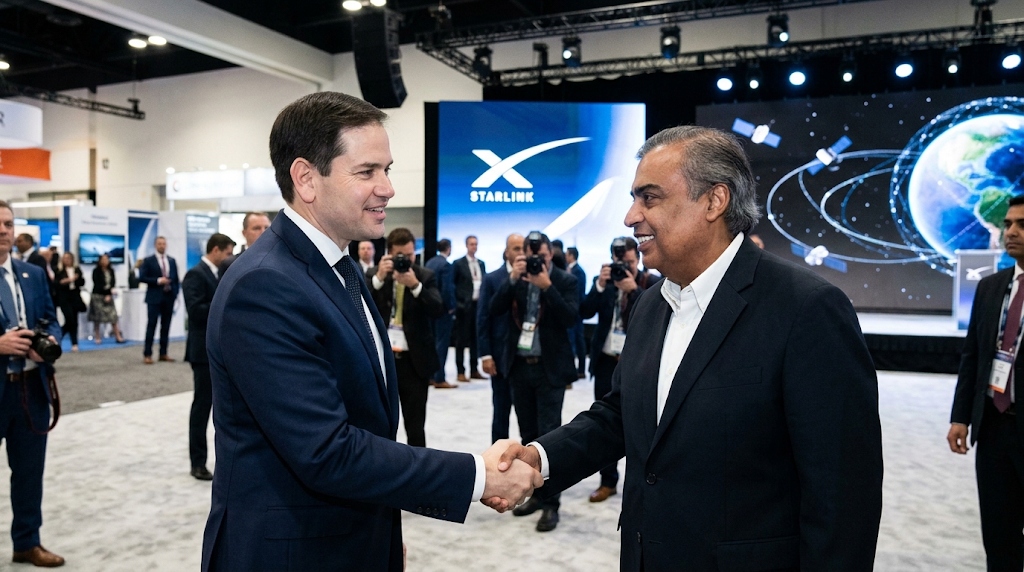 Diplomatic and corporate engagement in Gujarat. • Source
Indian Satellite Broadband Competitor Landscape
| Satcom Provider | Corporate Alliance | Constellation Architecture | Regulatory Clearance Status | Intended Market Focus |
|---|---|---|---|---|
| Starlink | SpaceX / Direct Consumer | ~6,000+ LEO Satellites | Final Security & Spectrum Audits | Direct-to-Consumer & Rural Internet |
| Jio Space Technology | Reliance Jio / SES S.A. | MEO & Geostationary Hybrids | Advanced In-Principle Approval | Enterprise, Backhaul & National 5G |
| Eutelsat OneWeb | Bharti Enterprises / Eutelsat | ~640+ Polar LEO Satellites | Full GMPCS License Granted | Defense, Maritime & Aviation Telecom |
| Amazon Kuiper | Amazon Web Services | Planned 3,200+ LEO Fleet | Licensing Application Under Review | Enterprise Cloud & Logistics |
 Fixed outdoor terminal installation. • Source
A Market Threshold on the Verge of Resolution
Despite the heated rhetorical exchanges, industry insiders suggest that a commercial breakthrough is imminent. Telecom industry audits indicate that Starlink has largely completed the operational modifications demanded by the Indian National Space Promotion and Authorization Center (IN-SPACe) and the Department of Telecommunications (DoT), including the establishment of local customer data mirroring and encryption decryption keys accessible to authorized intelligence services.
With India representing the world’s largest untapped digital market—home to vast mountainous terrains, island territories, and rural agricultural corridors where terrestrial fiber remains uneconomic—the entry of low-Earth-orbit satellite internet promises to unleash a new wave of educational, agricultural, and commercial empowerment. Whether spearheaded by Starlink, Jio, or OneWeb, the battle for India’s digital skies has officially shifted from bureaucratic backrooms into high-stakes global theater.
Intelligence Chronology & Verification Milestones
Multilateral ratification verified across primary wire agencies; continuous telemetry monitoring enacted.
Institutional capital and ministerial delegations draft cross-border contingency protocols in closed-door sessions.
Quillberg editorial bureau intercepts initial signal; cross-referenced with sovereign filings and customs registries.

