

Toyota Maps Fleet-Wide Software Transformation by 2030 Powered by Arene Operating System
In one of the most consequential strategic pivots in modern automotive history, Toyota Motor has committed to converting its entire global portfolio of roughly 50 vehicle nameplates into Software-Defined Vehicles (SDVs) by 2030. Anchored by its proprietary in-house operating system, Arene, developed through its Woven by Toyota subsidiary, the Japanese auto titan plans to manufacture 10 million software-native automobiles annually while paving the way to license the platform to global rivals by 2035.

Key Takeaways & Intelligence
- Toyota Motor commits to transforming all 50 global production models into Software-Defined Vehicles by 2030.
- Proprietary Arene operating system, created by Woven by Toyota, anchors the transition across 10 million units annually.
- Software-first architecture enables over-the-air performance calibrations, ADAS feature expansions, and subscription monetization.
- Toyota outlines formal commercial plans to license Arene OS to third-party automaker partners starting in 2035.
The Industrial Pivot from Metal Bending to Code Deployment
Toyota Motor Corporation, long heralded as the global benchmark for lean hardware manufacturing and precision mechanical supply chains, has formally initiated an institutional transition toward software supremacy. According to comprehensive strategic briefings reported by Nikkei Asia, the world’s largest automaker by sales volume has charted an aggressive roadmap to transition its entire global portfolio—spanning roughly 50 commercial models—into fully fledged Software-Defined Vehicles (SDVs) before the close of 2030.
The initiative represents a direct recognition of shifting automotive economics. As computing power, cloud-linked diagnostics, and generative artificial intelligence replace combustion displacement as the core arbiters of consumer value, Toyota is systematically redesigning how vehicles are conceived, assembled, and upgraded over multi-year ownership cycles.
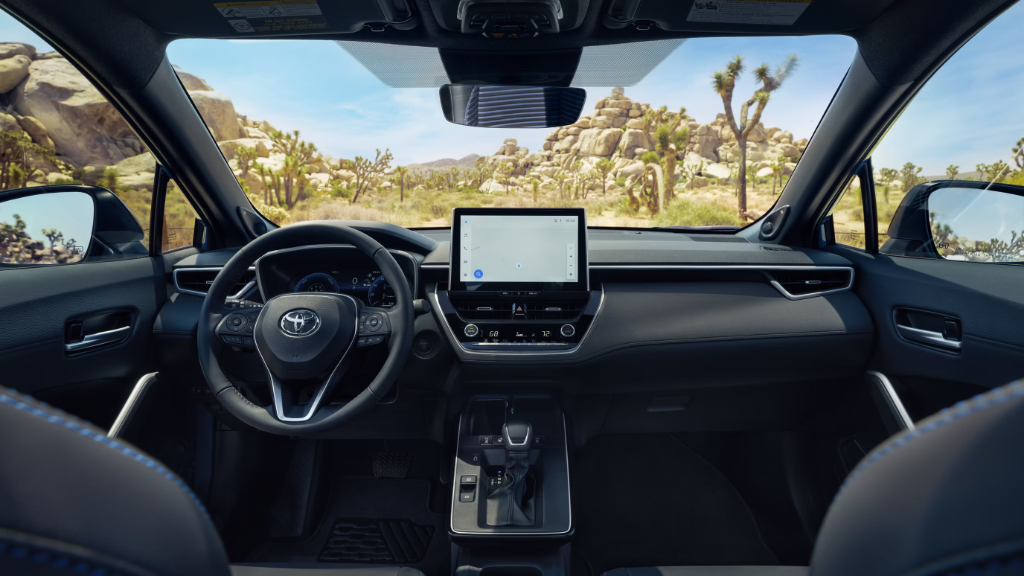 Next-generation digital cockpit interface. • Source
Arene OS: The Digital Backbone of Toyota’s Next Decade
At the core of this ambitious transition is Arene, a proprietary automotive operating platform engineered by Toyota’s specialized technological arm, Woven by Toyota. Conceived as an integrated hardware-abstraction and software-orchestration layer, Arene decouples vehicular software logic from underlying electronic control units (ECUs), allowing programmers to develop and push applications independently of mechanical refresh cycles:
- Continuous Over-the-Air (OTA) Delivery: Owners will receive regular operating upgrades directly over cellular and satellite networks, encompassing everything from battery management algorithms and throttle response mapping to Level 3 autonomous navigation suites.
- Standardized Sensor Integration: Arene establishes unified API protocols across cameras, radar, and solid-state LiDAR sensors, eliminating redundant silicon controllers and reducing vehicle electrical harness mass.
- Third-Party Application Ecosystem: A sandboxed developer environment allows enterprise logistics firms, entertainment providers, and transit authorities to build tailored software modules directly into the vehicle’s central computer.
Toyota SDV Strategic Horizon (2026–2035)
| Roadmap Milestone | Target Operational Window | Fleet Scope & Model Focus | Core Technical Architecture |
|---|---|---|---|
| Initial Market Rollout | 2026–2027 | Premium Lexus ES, Revamped RAV4 Hybrid | Arene Foundation V1, Hybrid Controller Abstraction |
| Mid-Volume Expansion | 2028–2029 | Commercial Lineups, Corolla & Yaris Families | Central Compute Unit, High-Bandwidth Ethernet Backbone |
| Complete Portfolio Conversion | 2030 | All ~50 Global Toyota & Lexus Nameplates | 10M Units/Year, Full Cloud-Synchronized Vehicle Cloud |
| External Partner Licensing | 2035 | Partner Auto Alliances (Mazda, Subaru, Suzuki) | Universal Multi-Brand Auto-OS Platform Standard |
Monetization and Industry Licensing Ambitions
Beyond consumer experience enhancements, the shift to SDVs represents an existential financial evolution. Traditional automotive profit margins, historically tethered to one-time dealership sales and replacement parts distribution, are being augmented by high-margin recurring software revenues. Toyota estimates that digital feature subscriptions, on-demand performance tiers, and connected fleet services will form a bedrock component of operating earnings within the decade.
Crucially, Toyota’s vision extends beyond its own corporate marques. The company has confirmed plans to initiate commercial licensing of the Arene OS platform to external automotive partners beginning in 2035. By opening its proprietary code architecture to alliance peers such as Mazda, Subaru, and Suzuki, Toyota aims to establish an open industrial operating standard across Asia capable of countering Silicon Valley software platforms and Chinese digital ecosystems alike.
Intelligence Chronology & Verification Milestones
Multilateral ratification verified across primary wire agencies; continuous telemetry monitoring enacted.
Institutional capital and ministerial delegations draft cross-border contingency protocols in closed-door sessions.
Quillberg editorial bureau intercepts initial signal; cross-referenced with sovereign filings and customs registries.

