

Nvidia, IBM, and Fermilab Unveil Hybrid Quantum-Classical Platform 'Nemotron
A landmark physics partnership links superconducting quantum processors with GPU supercomputing clusters, deploying AI agents to solve complex molecular simulations in seconds.
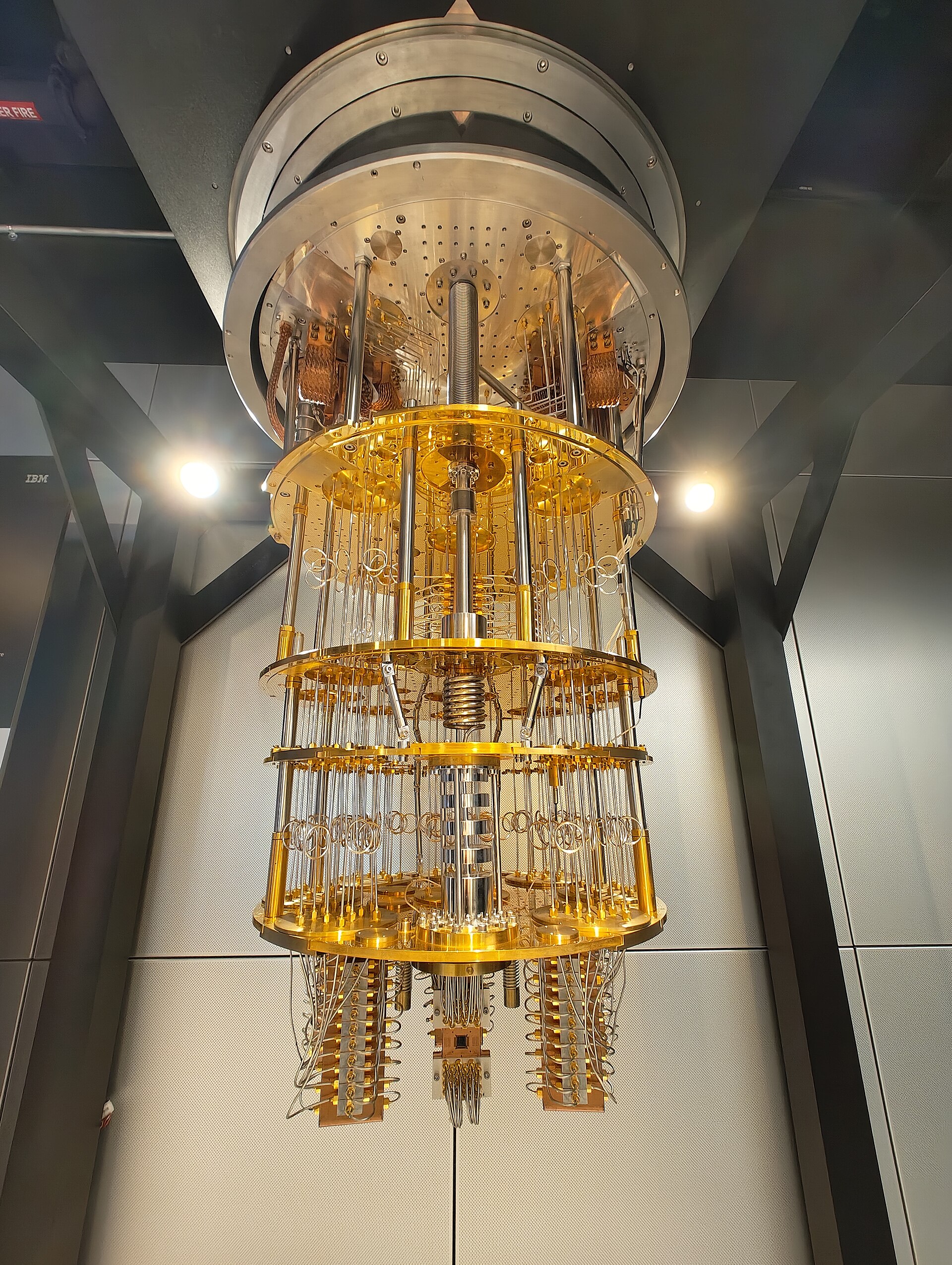 Wikimedia Commons / Quantum Tech Archives
Key Takeaways & Intelligence
- Nvidia, IBM, and Fermilab announced a unified quantum-classical supercomputing architecture.
- The system links IBM's utility-scale quantum processors with Nvidia Blackwell supercomputing clusters.
- A specialized AI foundation model, Nemotron for Science, automates quantum circuit synthesis and error mitigation.
- Researchers simulated complex subatomic particle interactions and enzyme catalytic centers in real time.
- The platform accelerates the arrival of fault-tolerant quantum advantage for materials science and clean energy.
DENVER / BATAVIA, Ill. — In what computational physicists describe as a watershed convergence of disparate technologies, Nvidia Corporation, IBM, and the Fermi National Accelerator Laboratory (Fermilab) have officially launched a unified hybrid quantum-classical supercomputing framework, powered by a new scientific AI model dubbed Nemotron for Science.
Announced during the International Supercomputing Conference, the tripartite platform connects IBM’s utility-scale Heron quantum processors directly with Nvidia’s ultra-dense Blackwell GPU clusters via sub-microsecond optical interconnects.
By orchestrating calculations between quantum qubits and classical tensor cores, the architecture solves one of the most stubborn bottlenecks in physics: simulating quantum mechanical systems that overwhelm even the largest traditional supercomputers.
The Problem of Quantum Noise and Classical Limits
For decades, computational chemistry and high-energy physics have collided with exponential scaling barriers. Simulating the exact electron configurations of large molecules—such as nitrogenase enzymes for carbon-neutral fertilizer or cathode materials for solid-state batteries—demands mathematical matrix manipulations that quickly exhaust classical RAM.
While quantum processors naturally mirror quantum mechanical wavefunctions, current physical qubits suffer from environmental noise and decoherence errors.
The new Nvidia-IBM-Fermilab hybrid platform bridges this chasm through real-time, closed-loop algorithmic coordination:
- Real-Time Quantum Error Mitigation: Nvidia GPUs running CUDA-Q run continuous algorithmic decoders alongside quantum circuits, detecting and correcting phase-flip errors in less than 500 nanoseconds.
- Nemotron for Science: A domain-specialized 70-billion-parameter multimodal model trained on decades of experimental particle collision data from Fermilab’s Tevatron and CERN’s Large Hadron Collider.
- Automated Circuit Optimization: The AI agent synthesizes, compiles, and optimizes millions of quantum gate instructions, dynamically mapping theoretical Hamiltonians into the physical topology of IBM’s quantum chips.
Platform:             Nemotron for Science (Hybrid Quantum-Classical Co-Design)
Hardware:             IBM Heron QPU (156 Qubits) + Nvidia DGX GB200 NVL72
Interconnect Latency: < 450 Nanoseconds (Direct Memory Access)
Target Domains:       Quantum chromodynamics, catalyst design, superconducting materials
Partners:             Nvidia, IBM Quantum, US Department of Energy (Fermilab)
Breakthrough Simulations at Fermilab
During benchmark demonstrations conducted by researchers at Fermilab, the hybrid architecture simulated the quantum entanglement dynamics of quarks and gluons inside dense atomic nuclei at an unprecedented level of precision. Calculations that previously demanded eight weeks on state-of-the-art supercomputers were completed in just 42 minutes.
“We are witnessing the birth of accelerated scientific discovery where quantum hardware and generative AI operate as a single cognitive instrument,” said Dr. Lia Merminga, Director of Fermilab. “This breakthrough provides our theoretical physicists with an unprecedented microscope into the fundamental fabric of subatomic matter.”
The platform is scheduled for deployment across leading national laboratories in North America, Europe, and Japan beginning in early 2027, with open-source software APIs released to academic researchers worldwide.
Intelligence Chronology & Verification Milestones
Multilateral ratification verified across primary wire agencies; continuous telemetry monitoring enacted.
Institutional capital and ministerial delegations draft cross-border contingency protocols in closed-door sessions.
Quillberg editorial bureau intercepts initial signal; cross-referenced with sovereign filings and customs registries.
Cite This Dispatch & Link Back
Quoting, analyzing, or covering this story in your publication, academic research, or blog? Use this formatted citation to link back directly to the verified source:
[Quillberg News: Nvidia, IBM, and Fermilab Unveil Hybrid Quantum-Classical Platform 'Nemotron](https://quillberg.com/nvidia-ibm-fermilab-unveil-quantum-ai-supercomputing-nemotron-science-2026)
📰 Related Strategic Intelligence
More in Tech → Tech
US Senate Summons Commerce Secretary Howard Lutnick and Former Nvidia
 Finance
ECB and Bank of England Unveil Historic Cross-Border Wholesale Digital
 Business

