

Singapore Researchers Thread First Touchscreen into Clothing: 54-Fibre Sleeve Runs Video and Survives the Wash
Materials engineers at the National University of Singapore have developed the first interactive, full-colour touchscreen woven directly into garment fabric. The 54-fibre sleeve displays video at 30 fps, registers multi-touch gestures, and retains full function after 50 cycles in a standard washing machine.
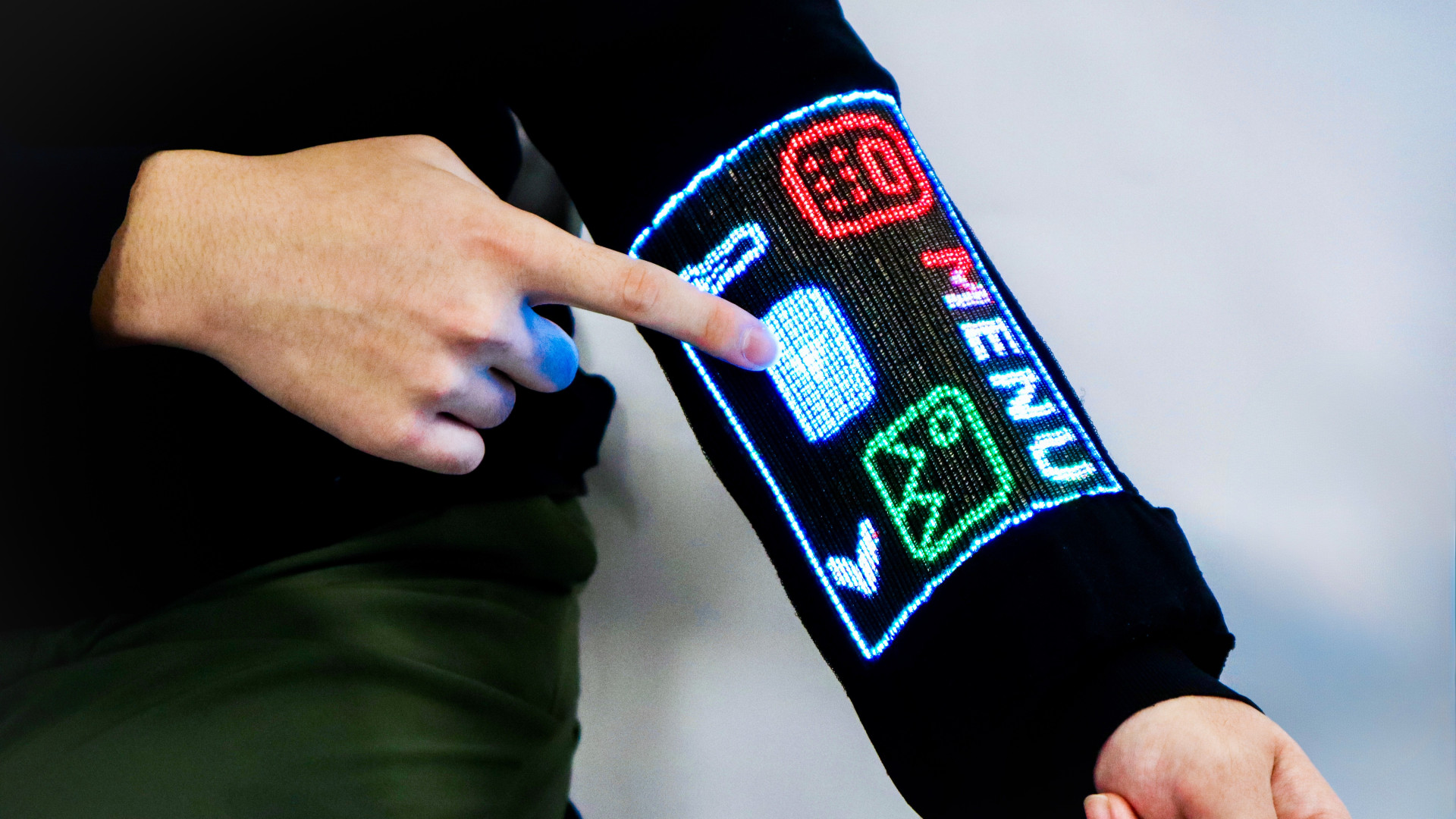 National University of Singapore (NUS) / College of Design and Engineering
Key Takeaways & Intelligence
- NUS researchers engineered a 1mm-thick composite fibre that integrates micro-LED pixels and capacitive touch sensors along a 10-metre drawn strand.
- The 54-fibre sleeve forms an active 96x54-pixel touchscreen operating at 30 fps, surviving 50 detergent washing machine cycles and 1,000 bends.
For years, the promise of “smart clothing” has collided with an unyielding reality: computer displays are flat, rigid glass slabs, while clothing is made of soft, one-dimensional yarns that bend, twist, and get tossed into washing machines. Previous efforts to build interactive garments meant gluing flexible plastic foils or brittle LED strips onto fabrics—leaving wearers with stiff, unbreathable patches that cracked after a few folds and died on contact with water.
That barrier fell this week. In findings published in the scientific journal Nature, a materials science team from the National University of Singapore’s (NUS) College of Design and Engineering demonstrated the world’s first functioning touchscreen built directly out of woven fibres, with no external glass panels or glued foils attached.
Led by Assistant Professor Tural Khudiyev, the NUS team threaded 54 multi-functional fibres into the forearm of a wearable shirt sleeve. The resulting textile display measures 168 mm by 105 mm, packs a 96 by 54-pixel grid, refreshes at 30 frames per second with 8-bit colour depth, and registers finger presses just like a smartphone panel.
Solving the Circuit Puzzle Along a Thread
Integrating electronics into a single thread has historically stumped engineers because traditional microchips require complex, two-dimensional circuit boards. Cylindrical fibres lack the surface area and geometry for standard wiring.
Khudiyev’s team bypassed this constraint by developing a programmable laser-soldering process. Microscopic insulated wires were selectively stripped with laser pulses at precise coordinates. Controlled surface tension then guided molten solder to bond microchips strictly at those programmed points—connecting over 5,000 chips across more than 20,000 electrical joints without manual intervention.
The resulting electronic strip was then enclosed inside a protective polymer jacket using thermal drawing, producing a continuous composite strand just 1 millimetre thick and 10 metres long.
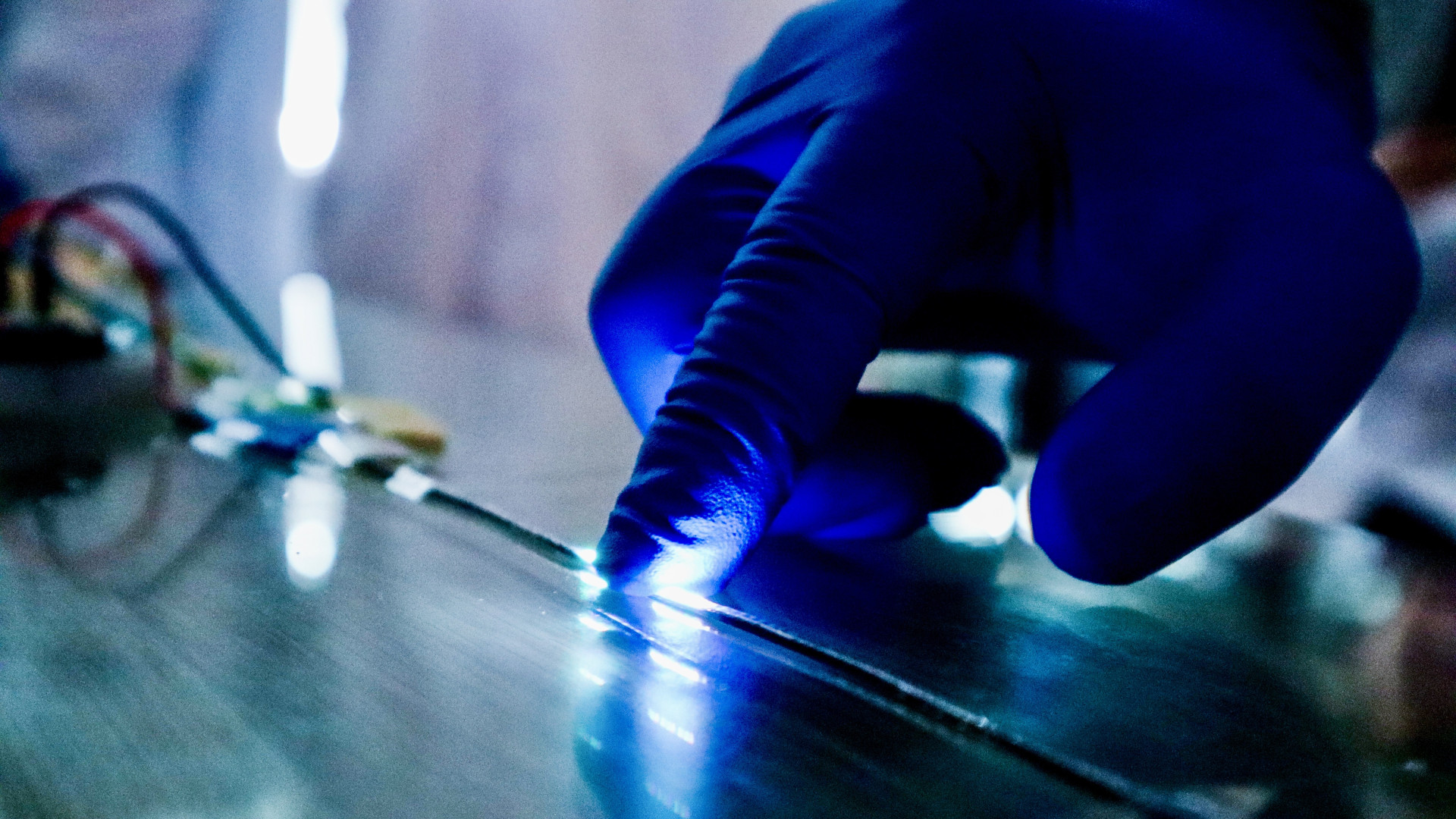 Beneath the micro-LEDs, a conductive sublayer registers touch. Finger pressure compresses the fibre to complete an electrical circuit, lighting the target pixel and logging multi-touch inputs. (Credit: National University of Singapore)
By routing each pixel fibre through an independent control channel, the architecture prevents cascade failures: if one thread breaks, adjacent lines keep running unaffected. The system also registers multi-touch gestures simultaneously across the 168 mm by 105 mm surface.
The Laundry Machine Test
A wearable display is useless if it cannot survive daily wear and tear. To test durability, the NUS researchers put the textile through commercial laundry stress tests.
After 50 full wash cycles with laundry detergent inside a household washing machine, the sleeve’s light output and touch sensitivity remained virtually unchanged. Mechanical testing showed the fibres survived over 1,000 continuous bends around a tight 5-millimetre radius. Despite containing thousands of microchips, the finished fabric matches standard cotton, polyester, and denim in breathability and sits safely within international thermal standards for prolonged skin contact.
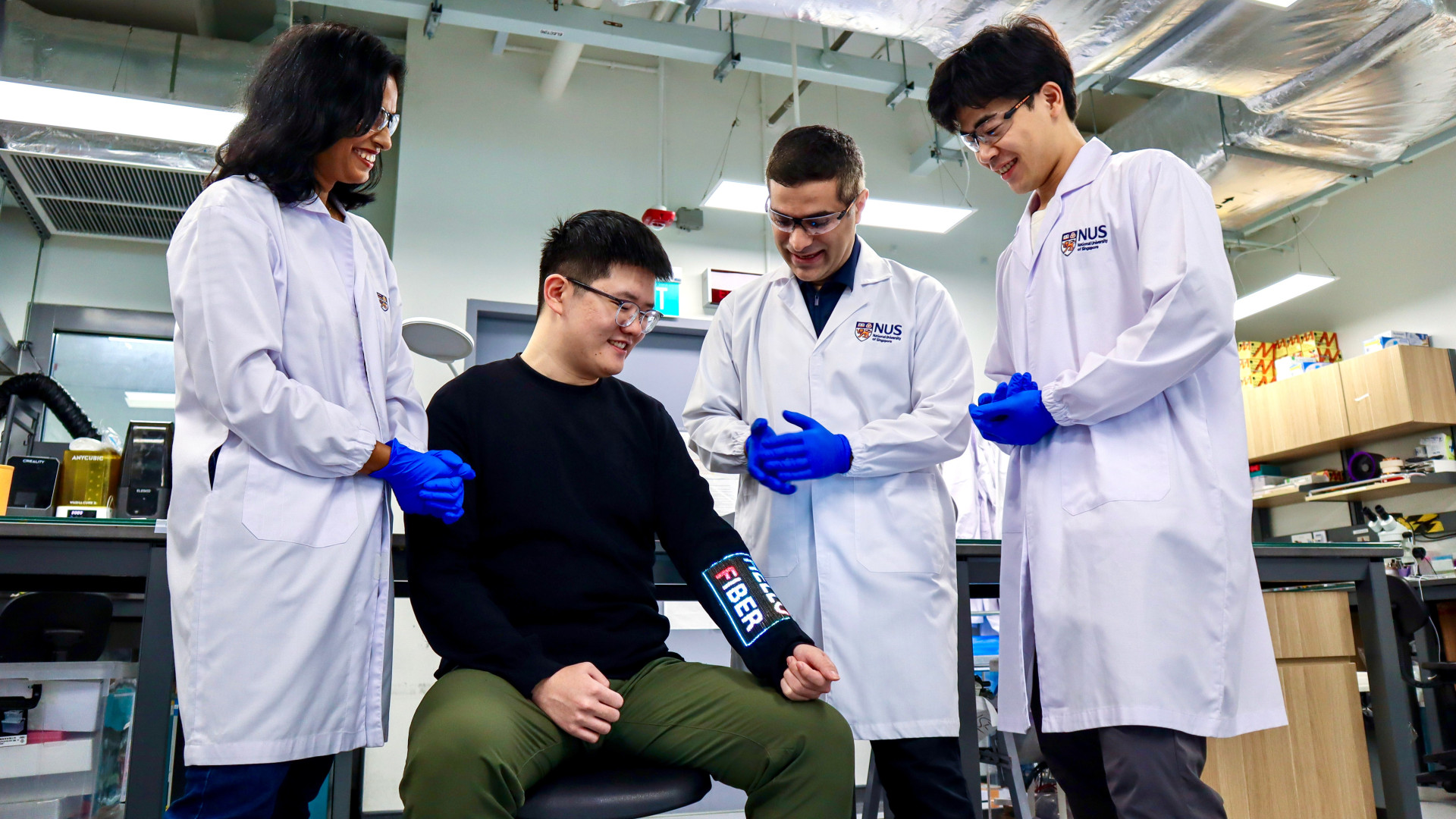 The NUS research team at the College of Design and Engineering: (from left) Swetika Chaturvedi, Ziang Li, Asst Prof Tural Khudiyev, and Heng Fu. (Credit: National University of Singapore)
From Forearm Calculators to Continuous Health Monitoring
In live bench tests, the NUS sleeve demonstrated several functions typical of early smartphones. Paired via Bluetooth, the forearm fabric ran an interactive calculator, displayed photo albums, streamed full-motion video at 30 fps (and 25 fps with synchronised audio), functioned as a digital compass, and received voice instructions through an integrated fibre microphone. A companion thermal fibre placed near the underarm tracked and projected body temperature changes onto the wrist in real time.
Because the display components are embedded inside the yarn itself rather than mounted on top, the NUS team confirms the threads can run through standard industrial looms and commercial embroidery equipment.
Khudiyev’s team is now working to shrink the microchip nodes further, aiming for higher pixel density and on-device machine learning. Their ultimate goal is clothing that can continuously monitor physiological vital signs, interpret health anomalies, and provide feedback directly on the wearer’s sleeve.
Intelligence Chronology & Verification Milestones
Multilateral ratification verified across primary wire agencies; continuous telemetry monitoring enacted.
Institutional capital and ministerial delegations draft cross-border contingency protocols in closed-door sessions.
Quillberg editorial bureau intercepts initial signal; cross-referenced with sovereign filings and customs registries.