SMS of Death' Zero-Click Bug Menaces Android Devices
Discovered by security researchers, the CVE-2026-58882 zero-click flaw bypasses user inboxes to instantly crash Android's telephony core, dropping calls and trapping unpatched devices in reboot loops.
Key Takeaways & Intelligence
- The 'SMS of Death' vulnerability (CVE-2026-58882) requires zero user interaction, executing silently via background binary WAP Push messages without triggering an inbox notification.
- An integer overflow flaw in Android's telephony decoding function triggers an unhandled NegativeArraySizeException, immediately crashing the critical com.android.phone system process.
- The exploit severs active cellular connections, drops ongoing emergency calls, and can trap vulnerable devices in continuous crash-and-reboot loops.
- Google rolled out patches in the October 2026 security bulletin for Android 14 through 17, but unmaintained devices on Android 12 and 13 remain exposed.
MOUNTAIN VIEW, California — A severe, zero-click vulnerability dubbed the “SMS of Death” has sent shockwaves across the mobile cybersecurity ecosystem. Tracked as CVE-2026-58882, the flaw allows remote attackers to crash an Android device’s cellular connectivity or even trap it in continuous reboot cycles by transmitting a single, malformed 8-byte text message.
Discovered and disclosed by independent security researcher Mark Blaszczyk, the exploit requires absolutely zero interaction from the target victim. The recipient does not need to click a link, open an attachment, or even inspect their messaging application. The crash executes silently at the operating system’s baseline telephony layer before any notification reaches the display screen.
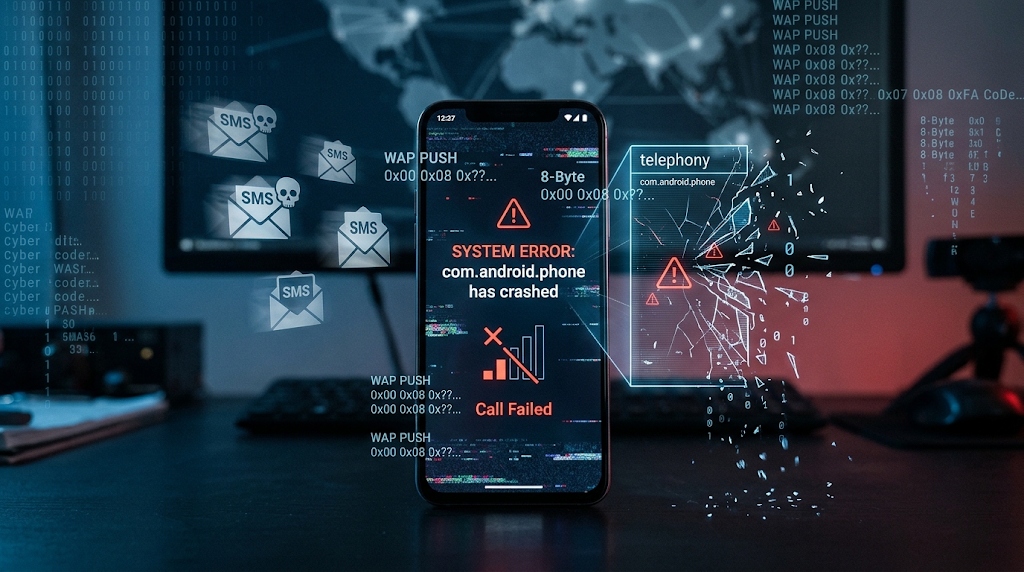
 The zero-click attack operates beneath the operating system interface, compromising telephony services without victim intervention. (AI Generated / Representative Visual)
The Anatomy of an 8-Byte Exploit
At the heart of CVE-2026-58882 lies a critical boundary validation oversight within Android’s open-source telephony framework—specifically inside the WapPushOverSms.decodeWapPdu decoding routine.
Mobile telecommunications networks rely on WAP Push Protocol Data Units (PDUs) to deliver carrier provisioning updates, MMS configurations, and specialized network settings over cellular port 2948. When an attacker transmits a maliciously crafted 8-byte binary SMS structured as a WAP Push message, the system reads a WSP header length parameter without proper bounds verification.
During decoding, the oversized unsigned integer is cast into a signed 32-bit integer, transforming it into the extreme negative value -2147483648. When Android attempts to allocate an in-memory byte array using this negative integer, the Java Virtual Machine throws an unhandled NegativeArraySizeException.
Because this exception occurs inside com.android.phone—the mission-critical system daemon managing the device’s radio interface layer (RIL) and cellular baseband—the entire telephony process abruptly terminates.
Real-World Threat: Dropped Calls and Reboot Loops
The practical implications of the SMS of Death extend far beyond ordinary application crashes. Because com.android.phone is the master process coordinating SIM authentication, mobile network registration, and voice routing, its sudden crash causes immediate consequences:
- Severe Communication Blackout: Active voice conversations disconnect instantly. Most dangerously, this includes critical calls placed to emergency services (such as 911 or 112).
- Carrier-Induced Bootloops: Because the recipient device crashes before dispatching a delivery receipt back to the cellular tower, telecommunications carriers repeatedly attempt to redeliver the message. Vulnerable phones can become trapped in a relentless 60-to-90-second crash-and-reboot loop.
- Complex Remediation: In testing environments, continuous delivery corrupted internal telephony databases, forcing researchers to deploy Android Debug Bridge (ADB) developer commands via USB or perform drastic full factory resets to restore basic phone utility.
Patch Availability and Critical Defenses
Google acknowledged the vulnerability and introduced official security remediations as part of its October 2026 Android Security Bulletin. The patch enforces strict unsigned bounds checking on all incoming WAP Push headers, safely discarding malformed payloads before memory allocation is initiated.
However, the patch distribution highlights a persistent challenge in the fragmented Android landscape:
- Supported Generations: Devices operating Android 14, Android 15, Android 16, and Android 17 that receive active monthly security patches are protected once updated.
- Unpatched Legacy Fleet: Devices locked to Android 12 and Android 13 that have surpassed their manufacturer support lifecycles remain structurally vulnerable unless original equipment manufacturers (OEMs) or community firmware maintainers backport the patch.
Cybersecurity authorities recommend that all Android users immediately navigate to Settings > System > System Update and verify that their device is operating with the October 2026 security patch level or later. Additionally, major telecommunication carriers have begun deploying network-level packet inspection filters to drop malformed port 2948 WAP Push traffic before it reaches subscriber hand-sets.
Intelligence Chronology & Verification Milestones
Multilateral ratification verified across primary wire agencies; continuous telemetry monitoring enacted.
Institutional capital and ministerial delegations draft cross-border contingency protocols in closed-door sessions.
Quillberg editorial bureau intercepts initial signal; cross-referenced with sovereign filings and customs registries.
Cite This Dispatch & Link Back
Quoting, analyzing, or covering this story in your publication, academic research, or blog? Use this formatted citation to link back directly to the verified source:
[Quillberg News: SMS of Death' Zero-Click Bug Menaces Android Devices](https://quillberg.com/android-sms-of-death-zero-click-telephony-crash-cve-2026-58882)