The Blue Surge: How Democrats Swept the 2026 Midterms, Seized
An inside look at the political earthquake that flipped both chambers of Congress: how historic flips in Texas, Ohio, and the Sun Belt dismantled the Republican majority and transformed Washington's power balance.

Key Takeaways & Intelligence
- Democrats executed an unprecedented double flip of the legislative branch, capturing a 54–44 Senate majority (+7 flips) and securing 225 House seats.
- The election unseated established conservative strongholds, highlighted by James Talarico's 12-point Senate upset in Texas and Sherrod Brown's blue-collar resurgence in Ohio.
- Suburban moderates and high youth turnout drove a 28-seat net gain in the House of Representatives, handing the Speaker's gavel back to Democratic leadership.
- In Georgia, Keisha Lance Bottoms made history by becoming the first African American woman elected governor in American history.
- The outcome imposes an immediate legislative veto on executive orders, reshaping judicial confirmations, foreign aid packages, and the road to the 2028 presidential campaign.
WASHINGTON — As the blue surge: how democrats swept the 2026 midterms, seized unfolds, in an extraordinary electoral reckoning that redefined the contours of American political power overnight, voters across the United States delivered an emphatic and sweeping verdict in the 2026 Midterm Elections. By capturing both the United States Senate and the House of Representatives, the Democratic Party dismantled conservative congressional majorities and established an unyielding legislative bulwark against Donald Trump’s second-term agenda.
By sunrise on Wednesday, certified race projections confirmed that Democrats had not merely defended their vulnerable turf—they mounted an aggressive offensive that penetrated deep into traditional Republican heartlands.
With 54 Senate seats and 225 House seats officially called, Washington wakes to an altered reality: a divided government where executive authority will now face intense subpoena power, legislative vetoes, and uncompromising budget oversight.

1. The Senate: Seven Seismic Flips Redefine the Upper Chamber (54–44)
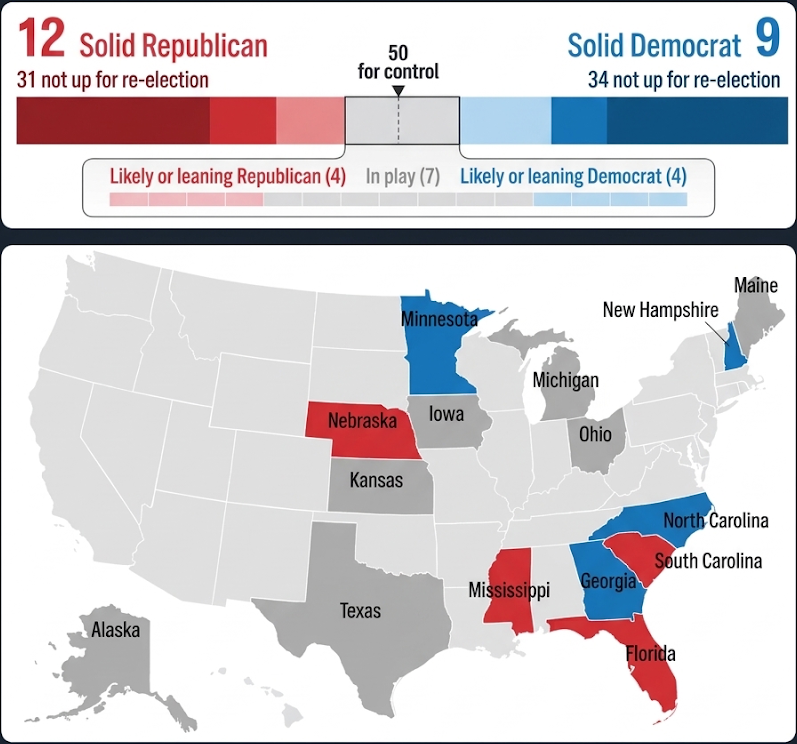
The path to the Senate majority was widely projected to be a razor-thin slog. Instead, it materialized as an expansive wave. Democrats not only crossed the 50-seat threshold in the early morning hours but expanded their advantage to 54 seats, generating a net pickup of seven seats over their Republican counterparts.
The centerpiece of the evening unfolded in Texas. In what historians and pollsters alike are classifying as the political earthquake of the decade, Democrat James Talarico toppled entrenched Republican leadership by an astonishing 12-point margin (D+12 with >95% reporting). Talarico’s coalition assembled unprecedented margins in suburban Dallas-Fort Worth, Williamson County, and Houston’s collar communities, combining economic populism with an aggressive defense of public education to turn the Lone Star State blue for the first time in three decades.
Similar upsets rippled across the map:
- Ohio (D+4, 94% in): Veteran labor advocate Sherrod Brown completed a dramatic political resurrection, reconnecting with union households across Mahoning and Stark counties to reclaim the Buckeye State.
- North Carolina (D+20, >95% in): Former two-term governor Roy Cooper crushed expectations in the Tar Heel State, running up dominant numbers in the Research Triangle and Charlotte to cruise to a 20-point blowout flip.
- South Carolina (D+4, >95% in): Dr. Annie Andrews stunned political observers by flipping South Carolina’s open seat, leveraging heavy coastal suburban turnout in Charleston and Columbia to edge out her GOP opponent.
- The Farm Belt Rebound (Iowa & Kansas): In Iowa, state lawmaker Turek captured a four-point victory (D+4), while in Kansas, Democratic nominee Hamilton notched a five-point upset (D+5), demonstrating that economic dissatisfaction in rural communities had broken sharply against the administration’s agricultural tariff policies.
- Maine (D+8, 87% in): Senate leader Jackson sealed New England’s blue firewall, flipping Maine’s contested seat behind overwhelming support in Cumberland and York counties.
Crucially, Democratic incumbents successfully guarded their most exposed flanks. In Michigan, progressive leader Abdul El-Sayed held off an aggressive challenge with a six-point cushion (D+6), while Peggy Flanagan in Minnesota (D+10) and Chris Pappas in New Hampshire (D+14) turned back heavily funded GOP bids.
2. The House of Representatives: Suburban Rebellion Clinches 225 Seats
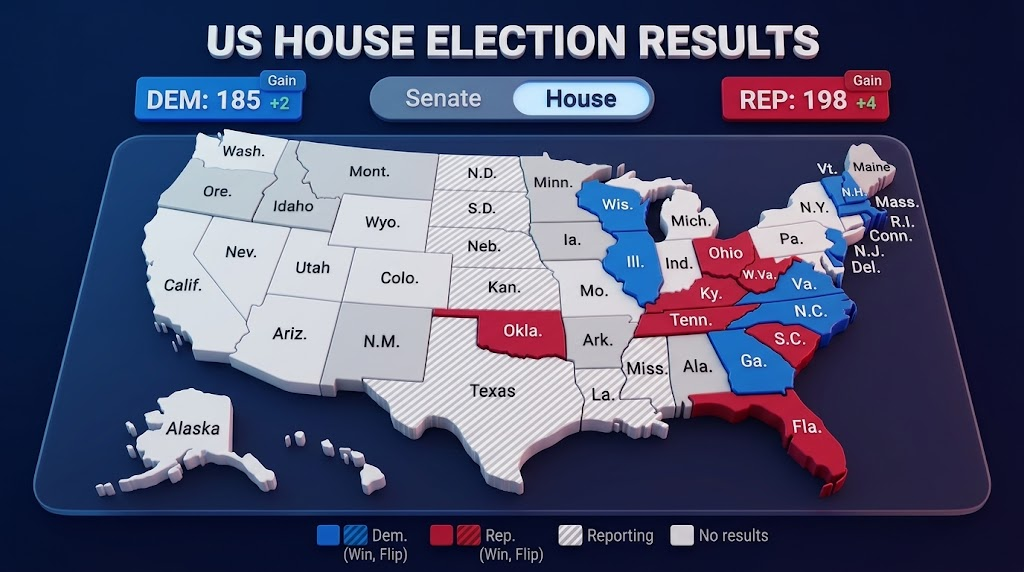
While the Senate demonstrated high-profile statewide strength, the battle for the House of Representatives proved the depth of the anti-administration current. Democrats shattered the 218-seat majority target, officially securing 225 seats against 137 seats for Republicans, with counting remaining in isolated Western precincts.
The Democratic net gain of 28 seats was powered by an undeniable suburban revolt. In collar districts surrounding Philadelphia, Atlanta, Phoenix, Richmond, and Long Island, educated suburban voters who had drifted rightward in 2024 returned en masse to the Democratic column. Key drivers cited by exit pollsters included mounting anxieties over persistent consumer inflation, aggressive federal administrative disruptions, and concerns over reproductive healthcare access.
With the speaker’s gavel returning to Democratic hands when the 120th Congress convenes in January, the entire architecture of Capitol Hill shifts overnight:
- Investigative Subpoena Power: House committees on Oversight, Judiciary, and Ways & Means will now be chaired by Democratic lawmakers, signaling immediate, aggressive probes into executive branch conduct, administrative appointments, and federal procurement.
- Fiscal Ceilings & Budget Impasses: Any future legislative proposals from the White House regarding tax policy, federal deregulation, or unilateral tariff mandates will be stopped cold at the Speaker’s desk.
3. A Milestone in Georgia: Keisha Lance Bottoms Makes History
Outside the halls of Congress, the 36 gubernatorial contests produced their own defining moment of the decade. In Georgia, former Atlanta mayor Keisha Lance Bottoms was officially declared governor, defeating Republican nominee Rick Jackson and becoming the first African American woman elected governor in the history of the United States.
Bottoms’ historic victory capped a grueling campaign where rural African American turnout in southwest Georgia merged seamlessly with surging young voters across Gwinnett, Cobb, and Fulton counties. The victory returned the governor’s mansion in Atlanta to Democratic hands for the first time since 2002.
Nationwide, Democrats retained or captured 27 state executive mansions compared to 20 for Republicans, including critical Midwestern flips in Iowa and New Hampshire, where former Manchester mayor Joyce Craig reclaimed the corner office in Concord.
4. What This Means for Global Alliances and Markets
The international reverberations of Tuesday’s vote were felt immediately across global financial capitals and diplomatic corridors. In Brussels, Tokyo, and London, allied leaders expressed quiet relief as the likelihood of unilateral American withdrawal from international treaty obligations and security pacts diminished.
- Foreign Aid & NATO Security: With Democrats commanding both the House and Senate appropriations committees, multi-billion-dollar security assistance pipelines for Ukraine and Pacific defense pacts are expected to move forward with renewed bipartisan safeguards against executive clawbacks.
- Trade & Tariff Constraints: The administration’s ability to impose across-the-board international tariffs faces immediate legislative pushback. Congressional leaders have already signaled plans to reassert statutory authority over international trade statutes under Article I of the Constitution.
- The Road to 2028: For Donald Trump, the loss of congressional control transforms the remainder of his second term into a defensive struggle. With his core legislative ambitions effectively halted and high-profile Democratic governors consolidating power in battleground states, the 2026 midterms have dramatically scrambled the chessboard for the upcoming presidential succession.
As election workers finalize the remaining tallies in Alaska and Nevada, one conclusion stands undisputed: the American electorate has drawn a sharp line on Capitol Hill, reshaping the balance of domestic power and setting the stage for two years of high-stakes divided governance.
Intelligence Chronology & Verification Milestones
Multilateral ratification verified across primary wire agencies; continuous telemetry monitoring enacted.
Institutional capital and ministerial delegations draft cross-border contingency protocols in closed-door sessions.
Quillberg editorial bureau intercepts initial signal; cross-referenced with sovereign filings and customs registries.
Cite This Dispatch & Link Back
Quoting, analyzing, or covering this story in your publication, academic research, or blog? Use this formatted citation to link back directly to the verified source:
[Quillberg News: The Blue Surge: How Democrats Swept the 2026 Midterms, Seized](https://quillberg.com/democrats-sweep-2026-midterms-flip-senate-house-rebuke-trump)