The Essential Guide to the 2026 U.S. Midterm Elections
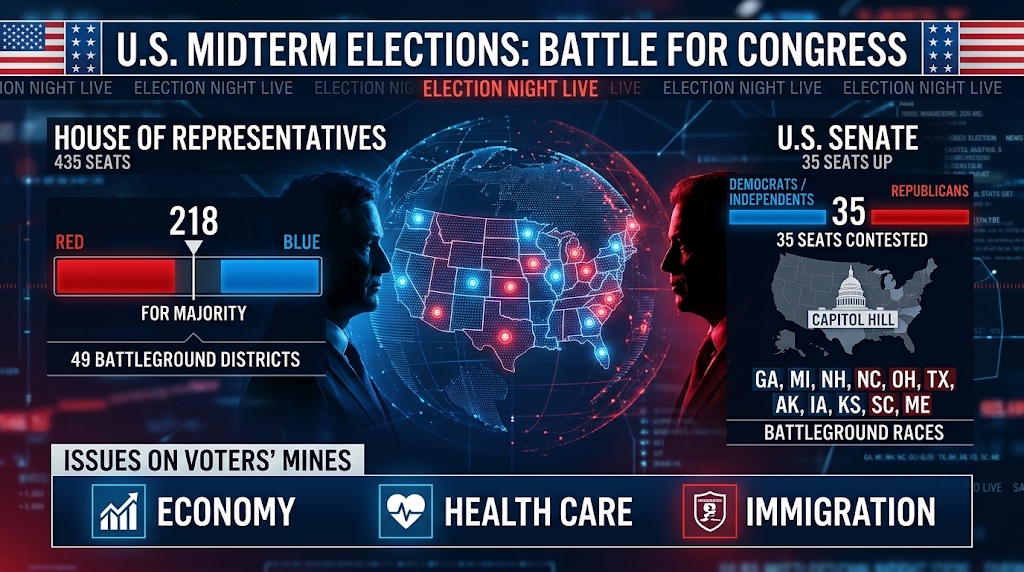
Everything you need to know about the 2026 U.S. midterm elections: the battle for 435 House seats, 35 Senate contests, historical presidential headwinds, and the worldwide stakes of Capitol Hill's power balance.
 Representative
Key Takeaways & Intelligence
- Midterm elections occur precisely two years into a U.S. presidential term, functioning as a high-stakes national referendum on the White House's executive record.
- All 435 seats in the House of Representatives and 35 of 100 Senate seats are up for election, alongside 36 state gubernatorial posts.
- Historical precedent creates severe headwinds for the incumbent administration, with the sitting president's party losing an average of 26 House seats in modern midterm cycles.
- The election outcome directly determines federal judicial confirmations, trade tariff enforcement, foreign defense assistance, and legislative funding gridlock.
WASHINGTON — Every two years, the American electorate participates in a constitutional reset that reverberates far beyond the borders of the United States. Halfway through Donald Trump’s second presidential term, voters across all 50 states have taken to the ballot box in the 2026 U.S. Midterm Elections.
While the presidency itself is not on the ticket, midterms serve as the definitive real-time verdict on executive performance, setting the legislative boundaries for the remaining two years of a president’s administration.
What Are Midterms, and What Is at Stake?
The U.S. legislative branch—Congress—is composed of two distinct chambers, both of which are fundamentally reshaped during midterm voting:
- The House of Representatives (All 435 Seats):
- Members of the House serve two-year terms, meaning the entire chamber faces re-election simultaneously.
- To hold a governing majority, a political party requires 218 seats.
- The House holds exclusive constitutional power to originate revenue bills, initiate federal budgets, and bring articles of impeachment.
- The United States Senate (35 of 100 Seats):
- Senators serve staggered six-year terms, with roughly one-third of the chamber elected every two years.
- This year, 35 seats are on the ballot—comprising 33 regular Class II seats alongside two critical special elections.
- The Senate commands unique authority to confirm Supreme Court justices, federal judges, cabinet secretaries, and ratify international treaties.
- State Governorships (36 Mansions):
- Across the country, 36 states are electing governors who oversee state budgets, reproductive health policies, voting access laws, and the command of state National Guard units.
The Senate Math: 50 for Control
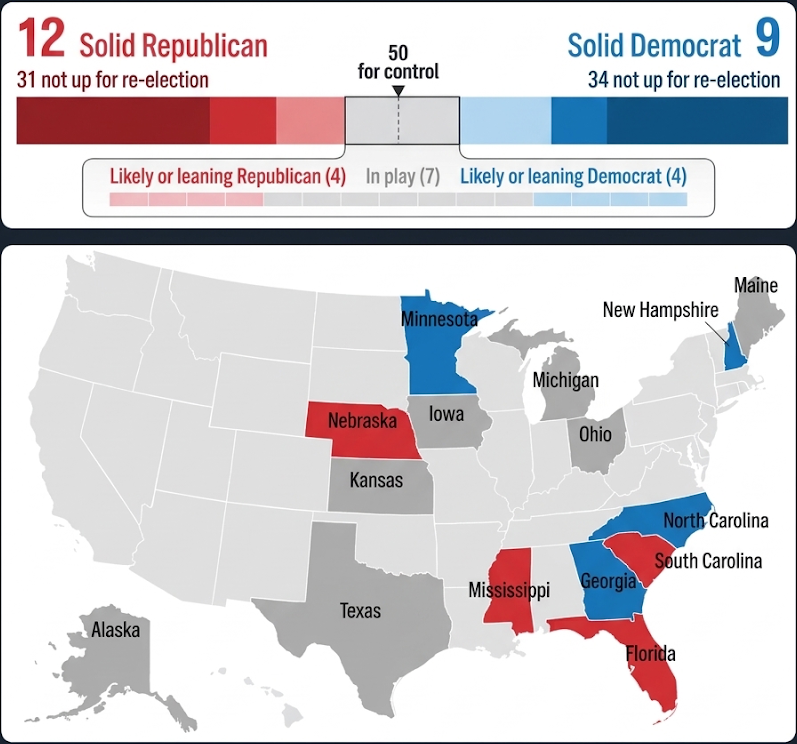
As illustrated in current non-partisan polling models, the pathway to a 50-seat Senate working majority hinges on a tight cluster of battleground races.
- The Republican Baseline: Entering Election Day, Republicans hold 31 seats not up for re-election, alongside 12 designated as “Solid Republican” and 4 leaning Republican (including Florida, Nebraska, and South Carolina).
- The Democratic Firewall: Democrats enter with 34 un-contested seats, 9 “Solid Democratic” holds, and 4 leaning Democratic states (including Minnesota and New Hampshire).
- The Seven Decisive Battlegrounds: The chamber’s ultimate balance of power rests squarely on seven races rated as statistical toss-ups or in play: Georgia, North Carolina, Michigan, Ohio, Texas, Iowa, and Maine.
Should Democrats flip even two net seats in these contested battlegrounds, they would effectively strip the White House of its unilateral judicial confirmation pipeline.
The Historical “Midterm Curse”
Political scientists frequently refer to the midterm election as the “midterm curse.” Historically, the president’s party almost invariably loses congressional seats:
- In the 22 midterm elections held since the conclusion of World War II, the sitting president’s party has surrendered House seats in 19 instances.
- The historical post-war average loss stands at 26 House seats and 4 Senate seats.
When an administration loses control of either chamber, Washington enters a phase of divided government. Major legislative priorities—ranging from sweeping tax overhauls to regulatory cuts—routinely grind to an abrupt halt, replaced by aggressive congressional subpoenas, oversight committee investigations, and fiscal brinkmanship over federal debt ceilings.
Global Implications: Why the World Watches
For international allies and global markets, the outcome of the U.S. midterms carries acute economic and geopolitical weight:
- International Trade & Tariffs: Executive proposals for sweeping universal import tariffs face direct statutory resistance if Congress is controlled by an opposition majority willing to challenge presidential tariff authorities under federal trade statutes.
- Foreign Defense Commitments: Congressional control dictates foreign military appropriations, humanitarian assistance, and the sustainability of ongoing security packages to Eastern Europe and the Indo-Pacific.
- Global Energy & Climate Policy: Federal clean energy tax incentives, fossil fuel export authorizations, and international climate pact enforcement are directly dictated by congressional committee chairs.
Poll Closing Waves (U.S. Eastern Time)
Due to the continental expanse of the United States, polling returns roll in progressively across five primary time zones throughout Tuesday evening:
- 7:00 PM EST (4:00 PM PT): Polls close across initial eastern states, notably bellwether Georgia, Virginia, and South Carolina.
- 7:30 PM EST (4:30 PM PT): Critical battlegrounds North Carolina and Ohio complete voting.
- 8:00 PM EST (5:00 PM PT): Major industrial corridor voting concludes, including Pennsylvania, Florida, New Hampshire, and Missouri.
- 9:00 PM EST (6:00 PM PT): The Midwestern “Blue Wall” closes in Michigan and Wisconsin, alongside Texas, Arizona, and New York.
- 10:00 PM EST (7:00 PM PT): Mountain West returns commence in Nevada, Utah, and Montana.
- 11:00 PM EST (8:00 PM PT): Western coastal polls close across California, Washington, and Oregon.
- 1:00 AM EST (Wednesday): The final polling station closes in Alaska’s Aleutian Islands.
Because several decisive swing states mandate that mail-in and provisional ballots can only be unsealed on Election Day, certified margins in the closest congressional districts may take several days to definitively declare.
Related Strategic Dispatches
- U.S. Midterm Elections 2026: Polls Open Nationwide as Control of Congress Hangs in Balance — Live coverage and district-by-district telemetry from voting precincts across America.
- Trump Confronts Historical Midterm Curse: ‘Presidents Usually Lose, Great or Lousy’ as Millions Vote Across America — Inside the historical precedent where incumbent administrations surrender legislative territory.
Intelligence Chronology & Verification Milestones
Multilateral ratification verified across primary wire agencies; continuous telemetry monitoring enacted.
Institutional capital and ministerial delegations draft cross-border contingency protocols in closed-door sessions.
Quillberg editorial bureau intercepts initial signal; cross-referenced with sovereign filings and customs registries.
Cite This Dispatch & Link Back
Quoting, analyzing, or covering this story in your publication, academic research, or blog? Use this formatted citation to link back directly to the verified source:
[Quillberg News: The Essential Guide to the 2026 U.S. Midterm Elections](https://quillberg.com/guide-to-the-2026-us-midterm-elections-stakes-senate-house)