

Kyiv Negotiates Urgent Starshield Satellite Extension with Pentagon to Safeguard
An investigative report on Ukraine's high-stakes negotiations to extend its Pentagon-funded SpaceX Starshield satellite contract: why low-Earth orbit constellation resilience is vital against Russian electronic warfare jamming and autonomous drone swarm warfare.
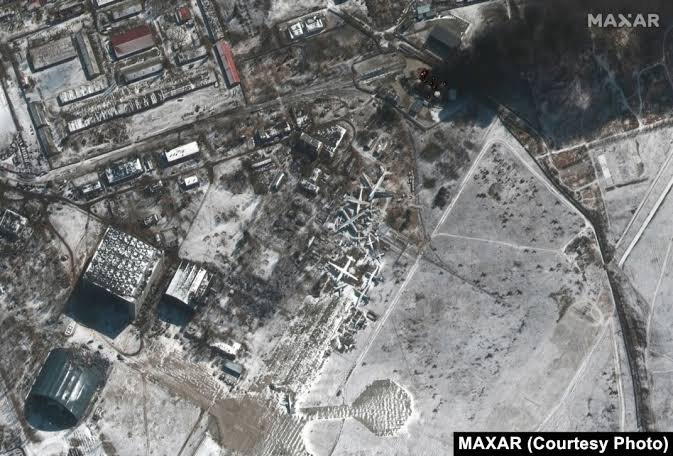 Maxar Technologies / Courtesy Photo
Key Takeaways & Intelligence
- Ukrainian defense officials are finalizing urgent contract extensions with the Pentagon to maintain uninterrupted access to SpaceX's military-grade Starshield satellite constellation.
- Starshield provides cryptographic hardware security, directional phased-array beams, and anti-jamming frequencies superior to commercial Starlink systems.
- Over 80 percent of Ukrainian long-range reconnaissance and FPV strike drones rely directly on orbital satellite uplinks for command and real-time telemetry.
- Russian forces have intensified frontline deployment of sophisticated electronic warfare complexes, attempting to sever battlefield tactical networks.
- Bipartisan support in Washington aims to lock in multi-year funding through the Ukraine Security Assistance Initiative to insulate orbital connectivity from political shifts.
KYIV & WASHINGTON — As kyiv negotiates urgent starshield satellite extension with pentagon to safeguard unfolds, in an era where modern mechanized warfare is commanded not from forward trenches but from secure underground bunker networks powered by gigabytes of real-time orbital data, a silent negotiation in Washington may determine the fate of Ukraine’s frontline defenses this winter.
Senior Ukrainian defense officials, operating in close coordination with the General Staff of the Armed Forces of Ukraine, have entered final-stage deliberations with the U.S. Department of Defense to extend the classified Starshield satellite communications agreement.
Built by SpaceX specifically for government and defense agencies and funded under the Pentagon’s Ukraine Security Assistance Initiative, Starshield has become the irreplaceable central nervous system of Ukraine’s asymmetric defense against Russian armored breakthroughs, aerial glide bomb campaigns, and electronic warfare attacks.
With the current multi-million-dollar operational charter approaching its scheduled renewal window, Ukrainian commanders have emphasized that any disruption in orbital service would paralyze tactical drone swarms, precision artillery coordination, and air defense interceptors across an active 1,000-kilometer front.

1. Beyond Starlink: The Technical Edge of Starshield
While commercial Starlink terminals captured global attention during the early months of the full-scale invasion in 2022, civilian terminals quickly proved vulnerable to targeted jamming and contested geopolitical restrictions.
Starshield represents a fundamentally different military-grade architecture:
- End-to-End Cryptographic Hardening: Unlike commercial channels, Starshield links integrate National Security Agency (NSA)-certified cryptographic key architectures that prevent hostile interception and man-in-the-middle spoofing.
- Frequency Agility & Jamming Resistance: Operating across dedicated military Ka-band and ultra-narrow directional Ku-band beams, the constellation can dynamically hop frequencies within milliseconds when Russian Krasukha-4 or Tirada-2 electronic warfare platforms attempt regional jamming.
- Dedicated Military Inter-Satellite Laser Links: Constellation nodes communicate directly in the vacuum of space through high-speed optical crosslinks, routing telemetry around terrestrial jamming bubbles without relaying through vulnerable regional ground downlink stations.
“Starshield transformed Ukrainian drone teams from isolated tactical units into an interconnected algorithmic force,” explains Colonel Mykhailo Fedorov, a communications adviser to Ukraine’s Armed Forces. “Without hardened low-Earth orbit satellite uplinks, deep-strike reconnaissance drones cannot transmit 4K infrared video back to HIMARS crews, and maritime drone attacks across the Black Sea would be rendered impossible.”
2. Russian Electronic Warfare Escalation
The urgency of the contract extension is driven by an unprecedented escalation in Russian counter-space and electromagnetic capabilities along the eastern Donbas and southern Zaporizhzhia axes.
Throughout late 2025 and 2026, Russian forces deployed dense chains of truck-mounted Zhitel and Borisoglebsk-2 electronic suppression systems along the frontlines. These systems flood the electromagnetic spectrum with thousands of watts of localized interference, blinding civilian GPS receivers and disrupting standard radio communications.
Satellite reconnaissance from western commercial providers has consistently documented the extensive physical fortification and electronic shielding of Russian airfields, ammunition depots, and command nodes. In response, Ukrainian strike brigades have adapted by wiring Starshield transceivers directly into long-range strike drones and naval uncrewed surface vehicles (USVs), allowing pilots stationed hundreds of kilometers away to guide strikes directly into hardened shelters.
3. The Washington Fiscal and Political Pipeline
Securing the multi-year extension requires navigating the newly elected 119th U.S. Congress, where control of both chambers shifted to Democratic majorities in the recent 2026 midterms.
Pentagon officials have confirmed that funding for the contract is structured through multi-year defense appropriations, designed to insulate tactical military communications from sudden political fluctuations. Bipartisan leaders on the Senate Armed Services Committee have expressed support for the continuity of the satellite grid, recognizing that orbital communications represent the single most cost-effective component of allied military assistance.
“Dollar for dollar, no defense investment provides more asymmetric battlefield leverage than hardened low-Earth orbit communications,” remarked an aide on the House Foreign Affairs Committee. “Starshield allows Ukrainian forces to punch far above their weight without placing a single American uniform on the battlefield.”
4. The Future of Orbital Sovereign Defense
As negotiations progress toward an official signing before year-end, the Ukrainian theater has irrevocably demonstrated that 21st-century sovereignty depends on space architecture.
European allies—including the United Kingdom, France, and Germany—are closely watching the Starshield deployment, accelerating their own sovereign low-Earth orbit defense constellations under the EU’s IRIS² initiative. Yet with European platforms still years away from full operational maturity, the Pentagon-backed SpaceX constellation remains the sole operational umbrella capable of withstanding near-peer electromagnetic assault.
For the drone operators and artillery spotters enduring freezing temperatures on the muddy frontlines of eastern Ukraine, the hum of a Starshield terminal is the thin digital thread that separates tactical survival from catastrophic defeat.
Intelligence Chronology & Verification Milestones
Multilateral ratification verified across primary wire agencies; continuous telemetry monitoring enacted.
Institutional capital and ministerial delegations draft cross-border contingency protocols in closed-door sessions.
Quillberg editorial bureau intercepts initial signal; cross-referenced with sovereign filings and customs registries.
Cite This Dispatch & Link Back
Quoting, analyzing, or covering this story in your publication, academic research, or blog? Use this formatted citation to link back directly to the verified source:
[Quillberg News: Kyiv Negotiates Urgent Starshield Satellite Extension with Pentagon to Safeguard](https://quillberg.com/ukraine-pentagon-starshield-satellite-grid-drone-defenses)
📰 Related Strategic Intelligence
More in World → World
Humanitarian Aid Agencies Issue Urgent Appeal as Famine Threatens
 World
Quad and ASEAN Unveil Comprehensive Indo-Pacific Maritime Radar and Satellite
 Tech

