UNESCO Opens 'A Shared Blue Heritage' Exhibition in Paris Celebrating
UNESCO launches a landmark open-air photographic exhibition along its Paris headquarters fences, marking a quarter-century of the 2001 Underwater Cultural Heritage Convention.
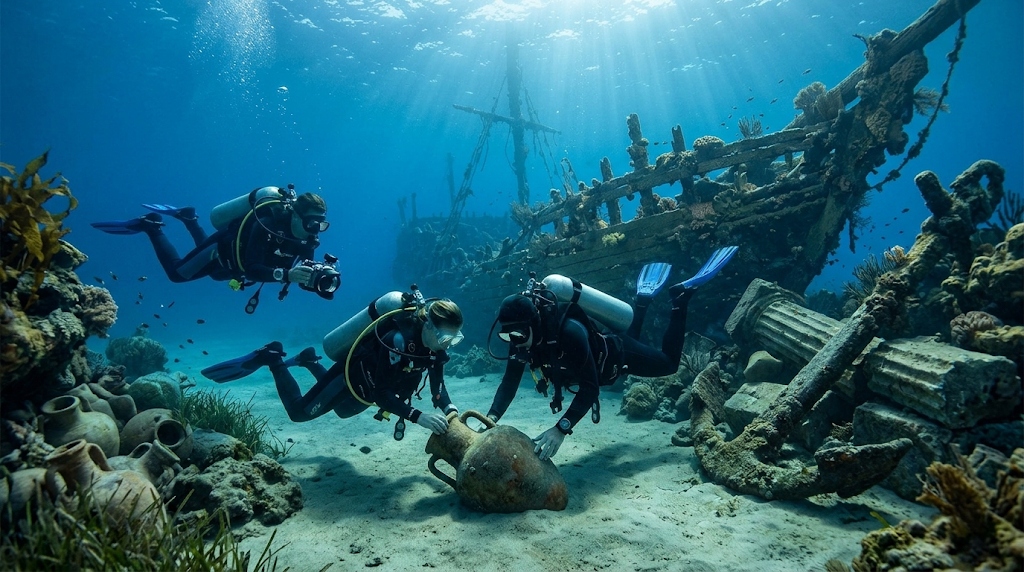 Representative / Visual Archive
Key Takeaways & Intelligence
- UNESCO's 'A Shared Blue Heritage' exhibition opened in Paris on November 2 and runs through December 31, 2026, commemorating 25 years of the 2001 Underwater Heritage Convention.
- Displayed along the exterior perimeter fences of UNESCO Headquarters, the free open-air installation showcases underwater photography and 3D photogrammetry of historic shipwrecks.
- The treaty has established strict global bans on commercial looting, treasure salvage, and the commercial exploitation of submerged cultural property across international waters.
- Curators highlight emerging ecological threats to submerged sites, including bottom trawling, seabed industrialization, and ocean acidification accelerating timber decay.
- The exhibition serves as a public awareness initiative ahead of international negotiations aimed at expanding state ratifications across major maritime nations.
PARIS — Spanning millennia of sunken human endeavor, UNESCO has opened a major open-air photographic exhibition titled “A Shared Blue Heritage” along the perimeter fences of its global headquarters in Paris, commemorating the 25th anniversary of the adoption of the 2001 Convention on the Protection of the Underwater Cultural Heritage.
Running from November 2 through December 31, 2026, the exhibition transforms the exterior railings of the UNESCO complex at 7 Place de Fontenoy into a public ocean gallery.
Through large-format, high-definition underwater photography, 3D laser photogrammetric renders, and historical field records, the installation invites passersby to explore ancient Phoenician trade galleys, sacred Maya cenotes, submerged Stone Age settlements in the North Sea, and sovereign maritime war graves resting in the abyssal depths.
The presentation serves a dual purpose: celebrating a quarter-century of international legal cooperation while warning that the world’s underwater cultural memory faces unprecedented existential risks from industrial bottom trawling, commercial treasure hunting, and climate-induced ocean warming.
 Photo: Sam Soffes / Wikimedia Commons (CC0 1.0)
The 2001 Convention: Outlawing the Plunder of the Deep
When the UNESCO General Conference ratified the Convention on the Protection of the Underwater Cultural Heritage in November 2001, the world’s seabed was effectively an unregulated frontier.
Armed with sonar, deep-submergence rovers, and saturation diving gear, commercial salvage operations routinely pillaged historic shipwrecks for gold doubloons, ancient porcelain, and bronze cannons, selling irreplaceable cultural artifacts at auction houses to private collectors.
The 2001 Convention established foundational principles that revolutionized international maritime law:
| Core Legal Principle | Operational Mandate | Field Impact |
|---|---|---|
| Prohibition of Commercial Exploitation | Submerged cultural heritage cannot be traded or auctioned | Disincentivized commercial treasure-hunting consortiums |
| In Situ Preservation as Preferred Option | Heritage should be preserved on the seabed where found | Protects organic waterlogged timbers in natural anaerobic silt |
| No Sovereign Immunity Waivers | Sunken naval vessels remain the property of flag states | Shields wartime naval graves from commercial intrusion |
| Information Sharing & State Cooperation | Mandatory notification of discovered cultural sites | Prevents illicit artifact trafficking across borders |
Source: UNESCO Secretariat of the 2001 Convention on the Protection of the Underwater Cultural Heritage.
Over the past 25 years, the convention has been ratified by more than 75 nations, successfully arbitrating complex multinational protection efforts—such as the historic collaborative safeguarding of the Skerki Bank maritime zone in the Mediterranean, jointly protected by Italy, Spain, France, Algeria, Croatia, Egypt, Morocco, and Tunisia.
Contemporary Threats: Trawling, Acidification, and Coastal Dredging
Curators emphasize that while commercial treasure hunting has been significantly curbed by legal prohibitions, new 21st-century environmental and industrial forces pose equal or greater peril:
- Industrial Bottom Trawling: Massive, weighted commercial fishing nets dragged across continental shelves indiscriminately smash delicate wooden shipwrecks, scattering ancient amphorae fields and obliterating stratigraphic context.
- Ocean Acidification and Warming: Shifting marine chemistry and elevated seawater temperatures accelerate the metabolic activity of wood-boring shipworms (Teredo navalis) and corrosive bacteria, causing hull timbers that survived centuries in anaerobic sediments to disintegrate rapidly.
- Offshore Infrastructure Expansion: The installation of subsea telecommunication cables, oil and gas pipelines, and offshore wind turbine foundations requires constant seabed trenching, necessitating rigorous cultural impact surveys prior to licensing.
“Underwater cultural heritage is not merely a collection of curiosities or lost treasures; it is an irreplaceable historical archive of human migration, seafaring, and climate adaptation,” noted Ernesto Ottone R., UNESCO Assistant Director-General for Culture. “Once destroyed, these submerged chapters of human history are lost forever.”
Visitor Guide and Public Access
Unlike traditional indoor museum exhibitions, A Shared Blue Heritage is mounted directly upon the street-level security fences encircling UNESCO’s 7th Arrondissement headquarters.
- Dates: Open daily from November 2 to December 31, 2026.
- Location: Perimeter fences of UNESCO Headquarters, Place de Fontenoy / Avenue de Suffren, Paris (accessible via Metro lines 6, 8, and 10).
- Access & Admission: Completely free and viewable 24 hours a day from the public sidewalk.
- Languages: Bilingual interpretive plaques in French and English, supplemented by QR codes linking visitors to virtual 3D site walk-throughs and educational resources.
The exhibition provides an accessible cultural journey for Parisians and international visitors alike, highlighting that the protection of the ocean depths extends far beyond biological biodiversity to the preservation of our common human history.
Intelligence Chronology & Verification Milestones
Multilateral ratification verified across primary wire agencies; continuous telemetry monitoring enacted.
Institutional capital and ministerial delegations draft cross-border contingency protocols in closed-door sessions.
Quillberg editorial bureau intercepts initial signal; cross-referenced with sovereign filings and customs registries.
Cite This Dispatch & Link Back
Quoting, analyzing, or covering this story in your publication, academic research, or blog? Use this formatted citation to link back directly to the verified source:
[Quillberg News: UNESCO Opens 'A Shared Blue Heritage' Exhibition in Paris Celebrating](https://quillberg.com/unesco-underwater-heritage-exhibition-paris-2026)