Voyager 1 Crosses Historic 'One Light-Day' Distance Milestone From Earth
NASA's iconic deep-space probe becomes the first human-made craft to operate 16.1 billion miles away, where radio signals take a full 24 hours to travel one way.
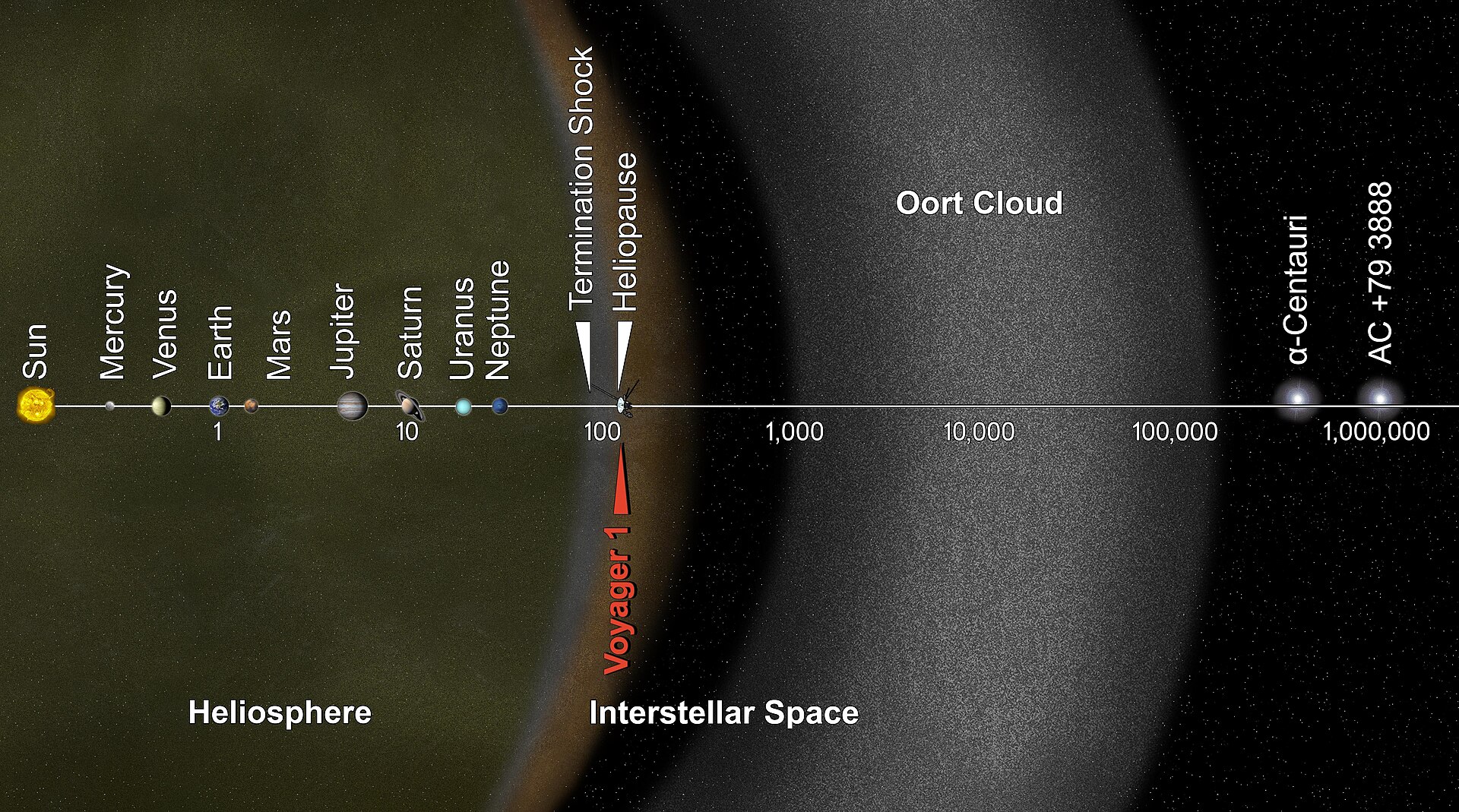 NASA / JPL-Caltech
Key Takeaways & Intelligence
- Voyager 1 has officially crossed the distance of one light-day (16.1 billion miles or 25.9 billion kilometers) from Earth.
- Radio transmissions moving at the speed of light now take a full 24 hours to reach the spacecraft, requiring 48 hours for round-trip telemetry.
- Launched in September 1977, the probe continues transmitting plasma and cosmic ray measurements powered by decaying Plutonium-238 RTGs.
- NASA Jet Propulsion Laboratory (JPL) engineers managed power budgets by disabling heaters to extend scientific operations.
- The spacecraft carries the Golden Record, destined to drift through the Milky Way galaxy for billions of years.
PASADENA, Calif. — In a historic milestone for human civilization and interplanetary exploration, NASA’s legendary Voyager 1 spacecraft has officially crossed the threshold of one light-day of distance from Earth. Located more than 16.1 billion miles (25.9 billion kilometers) from our home planet, the robotic explorer has ventured into a realm of the cosmos where even light, traveling at 186,282 miles per second (299,792 km/s), takes a full 24 hours to traverse the gulf between humankind and its farthest technological emissary.
The milestone marks the first time any human artifact has achieved a separation distance equivalent to a full day of light propagation. Any command transmitted by flight controllers at NASA’s Jet Propulsion Laboratory (JPL) via the colossal 70-meter parabolic dishes of the Deep Space Network (DSN) in Goldstone, Madrid, or Canberra now requires exactly 1,440 minutes to reach the spacecraft’s high-gain antenna—and another full day for engineers to observe the response in incoming telemetry.
The Physics of One Light-Day
To conceptualize the scale of one light-day, astrophysicists often compare it to familiar astronomical baselines. Sunlight reaches Earth in approximately 8.3 minutes, crosses the orbit of Jupiter in 43 minutes, and illuminates Neptune at the outer edge of our planetary neighborhood in just over four hours. Voyager 1 is now nearly six times farther from Earth than Neptune, voyaging through the true interstellar medium—the thin soup of charged particles, cosmic dust, and magnetic filaments that permeate the space between stars.
“Crossing one light-day is not merely a geometric landmark; it is a profound philosophical marker,” explained Dr. Suzanne Dodd, Voyager Project Manager at NASA JPL. “When our teams send a beacon to Voyager today, the spacecraft that receives it exists a full day in our future from the perspective of our radio waves. We are effectively communicating across temporal and spatial chasms never before navigated by humanity.”
| Metric | Voyager 1 Deep Space Specification |
|---|---|
| Separation Distance | ~16.1 Billion Miles (25.9 Billion km) |
| Speed of Light | 186,282 miles/sec (299,792 km/s) |
| One-Way Propagation | 24 Hours (1 Light-Day) |
| Round-Trip Delay | 48 Hours for Telemetry Round-Trip |
| Heliospheric Velocity | ~38,000 mph (61,000 km/h) relative to Sun |
An Unprecedented Feat of Engineering Endurance
Launched on September 5, 1977, aboard a Titan IIIE-Centaur rocket from Cape Canaveral, Voyager 1 was originally designed for a primary four-year mission focused on reconnaissance flybys of Jupiter and Saturn. After delivering breathtaking images of Jupiter’s Great Red Spot, volcanic eruptions on Io, and the complex rings of Saturn, the spacecraft’s trajectory was slingshotted out of the ecliptic plane into uncharted deep space.
In August 2012, Voyager 1 became the first spacecraft in history to cross the heliopause—the magnetic boundary where the solar wind gives way to the ambient interstellar interstellar medium. Today, nearly a half-century after its launch, the craft continues to send back invaluable scientific data utilizing its surviving instruments:
- The Cosmic Ray Subsystem (CRS): Measuring energetic interstellar ions and galactic galactic cosmic rays unshielded by the Sun’s magnetic bubble.
- The Magnetometer (MAG): Mapping the faint, ancient interstellar magnetic fields outside the solar system.
- The Plasma Wave Subsystem (PWS): Detecting localized density oscillations in interstellar plasma waves.
Operating these scientific payloads has demanded extraordinary ingenuity from ground controllers. Powered by three decaying Radioisotope Thermoelectric Generators (RTGs) fueled by Plutonium-238, the probe loses roughly 4 watts of electrical power each year. Over recent years, JPL engineers have executed meticulous power-conservation maneuvers, turning off non-essential systems, science heaters, and redundant thruster heaters to preserve critical operational margins.
Surviving Anomalies Across the Cosmic Void
Voyager 1’s journey to the one light-day mark has not been without dramatic technical challenges. Late last year and into early 2026, the spacecraft experienced a critical memory glitch when a single damaged chip in its Flight Data System (FDS) corrupted the telemetry stream, causing the spacecraft to broadcast an unreadable repetitive binary loop.
Working with code written in legacy assembly language and archived on printed paper manuals dating back to the mid-1970s, JPL flight software engineers diagnosed the hardware fault across 15 billion miles of vacuum. They successfully divided the affected code into modular subroutines and relocated them to healthy memory sectors, completely restoring scientific data transmissions without having physical access to the probe.
“The resilience of Voyager is a testament to the uncompromising standards of 1970s aerospace design and the dedication of generational teams at JPL,” noted mission scientist Dr. Linda Spilker. “Engineers who weren’t even born when Voyager lifted off are now collaborating with retirees who helped solder its original circuit boards.”
The Golden Record: Humanity’s Eternal Message
Strapped to the side of Voyager 1’s chassis is a 12-inch gold-plated copper phonograph record, encased in an aluminum protective jacket. Curated by a committee chaired by the late Carl Sagan, the Golden Record contains 115 analog photographs and diagrams, greetings spoken in 55 human languages, the sounds of Earth (wind, thunder, whale songs, and birds), and a 90-minute selection of global musical traditions ranging from Bach and Beethoven to Chuck Berry and traditional Azerbaijani bagpipes.
Voyager 1 is traveling outward at approximately 38,000 miles per hour (61,000 kilometers per hour) relative to the Sun. In roughly 40,000 years, the quiet explorer will pass within 1.6 light-years of the star AC+79 3888 (Gliese 445) in the constellation Camelopardalis.
Even after its nuclear battery inevitably cools into dormancy around the end of this decade, silencing its transmitters forever, Voyager 1 will drift silently through the Milky Way for billions of years—outliving the continents, the oceans, and potentially the Sun itself, an indestructible monument to humanity’s yearning to reach into the dark.
Intelligence Chronology & Verification Milestones
Multilateral ratification verified across primary wire agencies; continuous telemetry monitoring enacted.
Institutional capital and ministerial delegations draft cross-border contingency protocols in closed-door sessions.
Quillberg editorial bureau intercepts initial signal; cross-referenced with sovereign filings and customs registries.
Cite This Dispatch & Link Back
Quoting, analyzing, or covering this story in your publication, academic research, or blog? Use this formatted citation to link back directly to the verified source:
[Quillberg News: Voyager 1 Crosses Historic 'One Light-Day' Distance Milestone From Earth](https://quillberg.com/voyager-1-crosses-one-light-day-distance-historic-deep-space-milestone-2026)