One in Four Adolescents Reports No 60-Minute Active Day
WHO estimates roughly 240 million adolescents worldwide reported zero days with 60 minutes of moderate-to-vigorous physical activity in the previous week. A comprehensive investigation of The Lancet Global Health data, gender divides, and urban play deficits.
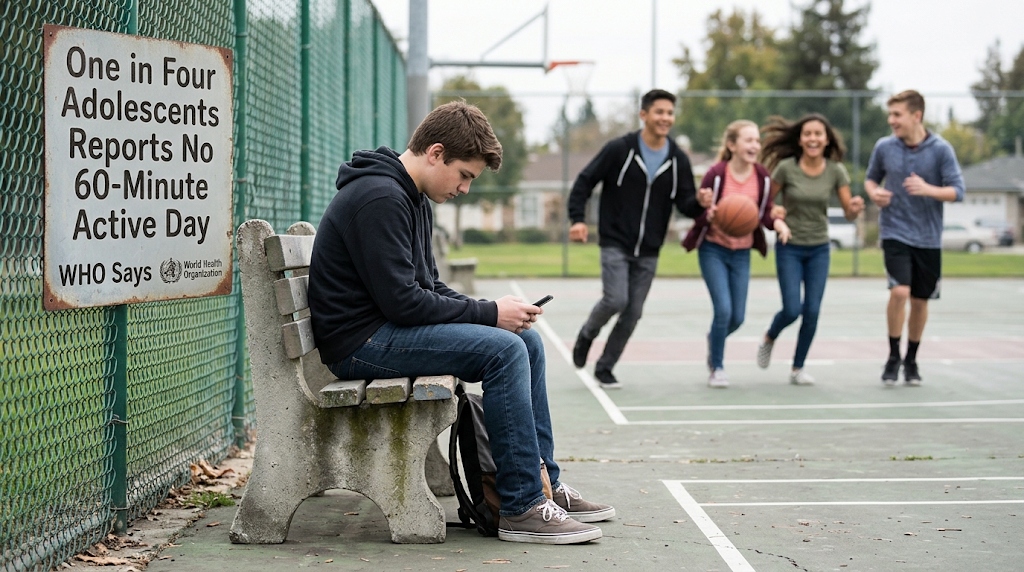 Digital Synthesis / Adolescent Health & Sedentary Behavior Study
Key Takeaways & Intelligence
- The World Health Organization (WHO) estimates that approximately 240 million adolescents aged 11 to 17 reported no day with at least 60 minutes of moderate-to-vigorous activity in the previous week.
- Published in The Lancet Global Health, the monumental research analyzed 389 population-based surveys representing over 3.2 million adolescents across 140 countries and territories.
- A persistent gender divide remains acute: 28 percent of adolescent girls reported zero active days compared to 22 percent of boys, while only 11 percent of girls met daily targets.
- Researchers emphasize that having no qualifying active day does not mean teens are completely immobile, but highlights failure to reach protective cardiovascular exertion thresholds.
- The WHO urges governments to overhaul urban recreational access, integrate daily physical education in schools, and combat passive screen saturation.
GENEVA & LONDON — In an alarming assessment of modern youth development, approximately one in four adolescents worldwide accumulated zero days over the past week with at least 60 minutes of moderate-to-vigorous physical activity, according to groundbreaking epidemiological estimates published by the World Health Organization (WHO).
The landmark study, appearing in The Lancet Global Health, paints a sobering portrait of the physical condition of contemporary youth. Translating the statistical rates across global demographic registries, the health agency estimates that roughly 240 million adolescents aged 11 to 17 are living entirely sedentary routines that fail to meet baseline cardiopulmonary health recommendations.
The analysis synthesizes data from 389 comprehensive population-based surveys spanning 140 nations and territories, drawing upon direct survey responses from more than 3.2 million adolescent participants. The findings underscore an entrenched global health crisis that has persisted virtually unchanged across the 15-year observation period analyzed by international researchers.
 Photo: World Health Organization (WHO) / United Nations Official Archives
Defining the “Active Day”: What the Threshold Signifies
Public health epidemiologists caution against misinterpreting the survey results as evidence that a quarter of the world’s teenage population never moves from a chair. The metric evaluated in the study possesses a rigorous and specific scientific threshold: an “active day” is defined strictly as one in which a participant accumulates a cumulative total of at least 60 minutes of physical activity at moderate-to-vigorous intensity.
Under this clinical benchmark, activities such as brisk walking, cycling, team sports, swimming, martial arts, or high-intensity playground games count toward the threshold. Conversely, incidental movement, slow strolls between classes, or light chores that do not accelerate heart rates into aerobic zones are excluded.
Consequently, an adolescent who engages in 30 or 40 minutes of energetic movement per day is recorded as having zero qualifying active days—despite exerting themselves significantly more than someone who remains entirely motionless.
Nonetheless, medical authorities warn that dropping below the 60-minute daily mark robs developing bones, muscles, and hormonal systems of the mechanical and vascular stresses required to optimize lifelong cardiometabolic resilience.
The Data in Focus: Global Adolescent Activity Metrics
The epidemiological investigation revealed striking asymmetries across gender lines, demonstrating that teenage girls consistently face greater structural and cultural impediments to regular sports and exercise.
| Surveyed Metric | Adolescent Girls | Adolescent Boys | Combined Average |
|---|---|---|---|
| Zero Qualifying Active Days in Previous Week | 28% | 22% | 25% |
| 1 to 3 Qualifying Active Days | 39% | 34% | 36.5% |
| 4 to 6 Qualifying Active Days | 22% | 27% | 24.5% |
| Qualifying Active Days on All 7 Days | 11% | 17% | 14% |
Source: World Health Organization & The Lancet Global Health analysis of 389 population-based surveys across 140 countries and territories.
The 6-percentage-point gap between girls and boys reporting zero active days highlights deeply rooted disparities in access to safe recreational spaces, after-school athletics, and culturally inclusive physical education curricula. In only a tiny minority of regions did adolescent girls achieve parity with their male peers in meeting daily aerobic recommendations.
National Nuances: Oxford Analysis Highlights Local Disparities
While global figures demonstrate a stubborn lack of momentum over the past decade and a half, granular regional evaluations highlight meaningful national variations. An independent summary conducted by researchers at the University of Oxford examining localized cohorts in the United Kingdom observed that while overall activity remains suppressed, domestic participation exceeds global nadirs:
- 21% of UK boys and 13% of UK girls achieved qualifying moderate-to-vigorous physical activity on all seven days of the tracking period.
- Socioeconomic background heavily modulated youth engagement, with adolescents living in urban zones lacking green parks or community athletic facilities exhibiting significantly higher rates of zero-active weeks.
- Digital recreation and academic homework loads were frequently cited by participants as the dominant barrier competing against outdoor sports.
Dr. Fiona Bull, head of the WHO Physical Activity Unit, emphasized that the lack of progress between 2010 and 2025 demonstrates that passive public health advice is inadequate to counter powerful modern environmental shifts.
“We are witnessing an entire generation coming of age in environments engineered for physical stillness. From sprawling car-centric cities and unsafe cycling paths to screen-based social connectivity, the barriers to natural daily movement are structural, not individual moral failures.”
Interlocking Catalysts: Screens, Urban Density, and Curricular Neglect
Public health sociologists point to a confluence of technological and urban factors that have reshaped teenage daily life:
- Passive Screen Proliferation: The ubiquity of smartphones, algorithmic short-form video feeds, and immersive multiplayer gaming has replaced casual neighborhood play. Screen time routinely exceeds six to eight hours of discretionary time per day for high-income and middle-income youth.
- Erosion of School Physical Education: Under mounting competitive testing pressure, school districts worldwide have curtailed physical education hours, recess durations, and mandatory athletic programming to allocate more classroom time to exam prep.
- Automated and Motorized Transit: Adolescents who previously walked or cycled to school are increasingly transported in private automobiles or public transit, eliminating what historically provided a built-in 30 to 45 minutes of daily physical exertion.
- Safety Concerns and Vanishing Play Spaces: In dense metropolitan areas, rapid urbanization has swallowed public parks, greenbelts, and basketball courts, while parents increasingly restrict independent outdoor exploration due to vehicular traffic hazards.
Policy Roadmap: Rebuilding the Ecosystem of Youth Movement
The World Health Organization accompanied its dataset with an urgent policy framework directing national education, urban planning, and health ministries to implement coordinated countermeasures:
- Mandatory Daily School PE: Guaranteeing at least 45 to 60 minutes of active, structured movement during the school day, designed to be enjoyable and non-intimidating for non-competitive athletes.
- Protected Active Travel Networks: Constructing continuous, well-lit, physically segregated cycling tracks and wide sidewalks to enable safe walking and scootering commutes to schools and community hubs.
- Subsidized Community Recreation: Ensuring that municipal sports centers, swimming pools, and community basketball and soccer fields are freely accessible or low-cost, particularly in lower-income zip codes.
- Incremental Movement Recognition: Health agencies emphasize that any movement is vastly superior to zero movement. Reaching 20 or 30 minutes of energetic activity generates tangible reductions in adolescent depression, anxiety, and insulin resistance.
As national health systems grapple with rising rates of juvenile type 2 diabetes, adolescent hypertension, and psychological distress, the WHO report serves as a timely reminder that physical activity is not a luxury pastime, but a foundational biological pillar of human development.
Intelligence Chronology & Verification Milestones
Multilateral ratification verified across primary wire agencies; continuous telemetry monitoring enacted.
Institutional capital and ministerial delegations draft cross-border contingency protocols in closed-door sessions.
Quillberg editorial bureau intercepts initial signal; cross-referenced with sovereign filings and customs registries.
Cite This Dispatch & Link Back
Quoting, analyzing, or covering this story in your publication, academic research, or blog? Use this formatted citation to link back directly to the verified source:
[Quillberg News: One in Four Adolescents Reports No 60-Minute Active Day](https://quillberg.com/who-adolescent-physical-activity-study-2026)