ESA Hera Captures Rare Solar Eclipse Between Twin Asteroids
European Space Agency probe Hera beamed home breathtaking navigation imagery from 121 million miles away, revealing moonlet Dimorphos casting a sharp solar eclipse shadow onto its larger companion asteroid Didymos.
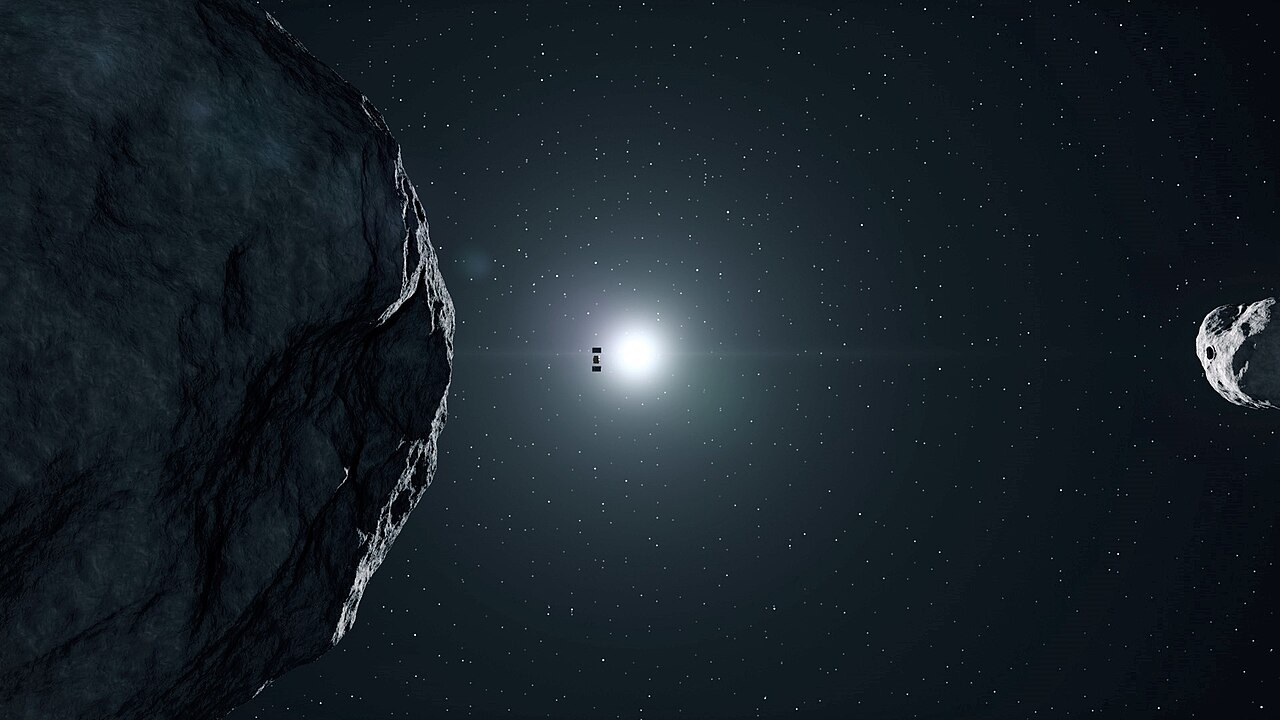 ESA / CC BY-SA 3.0 IGO
Key Takeaways & Intelligence
- Stationed 121 million miles from Earth, ESA's Hera probe captured asteroid moonlet Dimorphos eclipsing parent body Didymos.
- Monochrome imagery from Hera's Asteroid Framing Camera shows 151-meter Dimorphos blocking sunlight across rocky Didymos craters.
- Hera arrived this month to conduct an unprecedented forensic crime-scene inspection following NASA's 2022 DART impact.
- Data on asteroid mass, rubble composition, and crater geometry will calibrate humanity's future planetary defense strategies.
DARMSTADT, GERMANY — Operating 121 million miles away in deep space, the European Space Agency’s (ESA) Hera planetary defense spacecraft has beamed back a mesmerizing astronomical portrait: an asteroid solar eclipse playing out across a miniature alien world.
Captured by Hera’s monochrome Asteroid Framing Camera as the probe settled into its orbital survey of the Didymos binary asteroid system, the frame reveals the 151-meter moonlet Dimorphos slicing directly between the Sun and its 730-meter parent asteroid, Didymos.
Cosmic Shadows at Miniature Scale
Just as Earth’s Moon casts a cone of darkness during terrestrial total eclipses, Dimorphos—orbiting scarcely one kilometer above Didymos—projected a stark, sharp-edged shadow cleanly across the larger rock’s boulder-strewn equatorial terrain.
ESA planetary mission teams released the shot ahead of close-range orbital science sweeps beginning this week, showcasing celestial mechanics unfolding across two loosely bound rubble-pile bodies drifting far beyond Mars’s neighborhood.
Forensic Survey of NASA’s DART Impact
Hera’s optical navigation triumph sets the stage for humanity’s first detailed forensic investigation of an intentionally deflected celestial body. In September 2022, NASA’s DART spacecraft slammed into Dimorphos at hypervelocity, measurably altering its orbital path around Didymos in an epochal planetary defense test.
Over the coming months, Hera and two deployable CubeSats—Milani and Juventas—will map the impact crater left behind by DART, weigh Dimorphos precisely, and probe internal asteroid structure with radar. Scientists warn those exact density measurements are indispensable should future astronomers ever detect a hazardous asteroid bound for Earth.