

NASA Executes Dual Earth Flybys to Catapult Twin ESCAPADE Spacecraft
NASA coordinates two high-precision powered Earth flybys on November 7 and 9, 2026, utilizing gravity-assist maneuvers and nine-minute engine burns to slingshot the twin ESCAPADE probes on a 10-month trajectory to Mars.
 Representative / NASA Public Domain
Key Takeaways & Intelligence
- NASA has scheduled high-precision powered Earth flybys on November 7 and 9, 2026, to slingshot the twin ESCAPADE spacecraft toward Mars.
- Each trajectory maneuver combines Earth's gravitational pull with a critical nine-minute orbital engine burn near closest approach.
- Constructed by Rocket Lab and managed by UC Berkeley, the identical 'Blue' and 'Gold' orbiters will conduct unprecedented dual-point measurements of solar wind erosion.
- Following a 10-month interplanetary transit, the probes are scheduled to enter elliptical Martian orbits on September 7 and 9, 2027.
- The mission serves as a flagship pathfinder for NASA's SIMPLEx program, demonstrating low-cost, high-science interplanetary planetary exploration.
WASHINGTON & CAPE CANAVERAL — In an intricate choreography of celestial mechanics and orbital rocketry, NASA has initiated a crucial sequence of powered Earth flybys designed to slingshot its twin ESCAPADE spacecraft out of orbital holding loops and onto a high-speed trajectory toward Mars.
Short for the Escape and Plasma Acceleration and Dynamics Explorers, the dual-spacecraft planetary science mission represents a pioneering milestone in cost-effective deep-space exploration. Built by commercial space pioneer Rocket Lab and overseen by the University of California, Berkeley’s Space Sciences Laboratory, ESCAPADE consists of two identical orbiters—informally nicknamed Blue and Gold.
The probes are tasked with answering one of planetary science’s most fundamental questions: how the ceaseless, highly energetic stream of particles radiating from the Sun stripped Mars of its ancient, dense atmosphere and transformed a once-warm, water-rich world into the frozen desert we observe today.
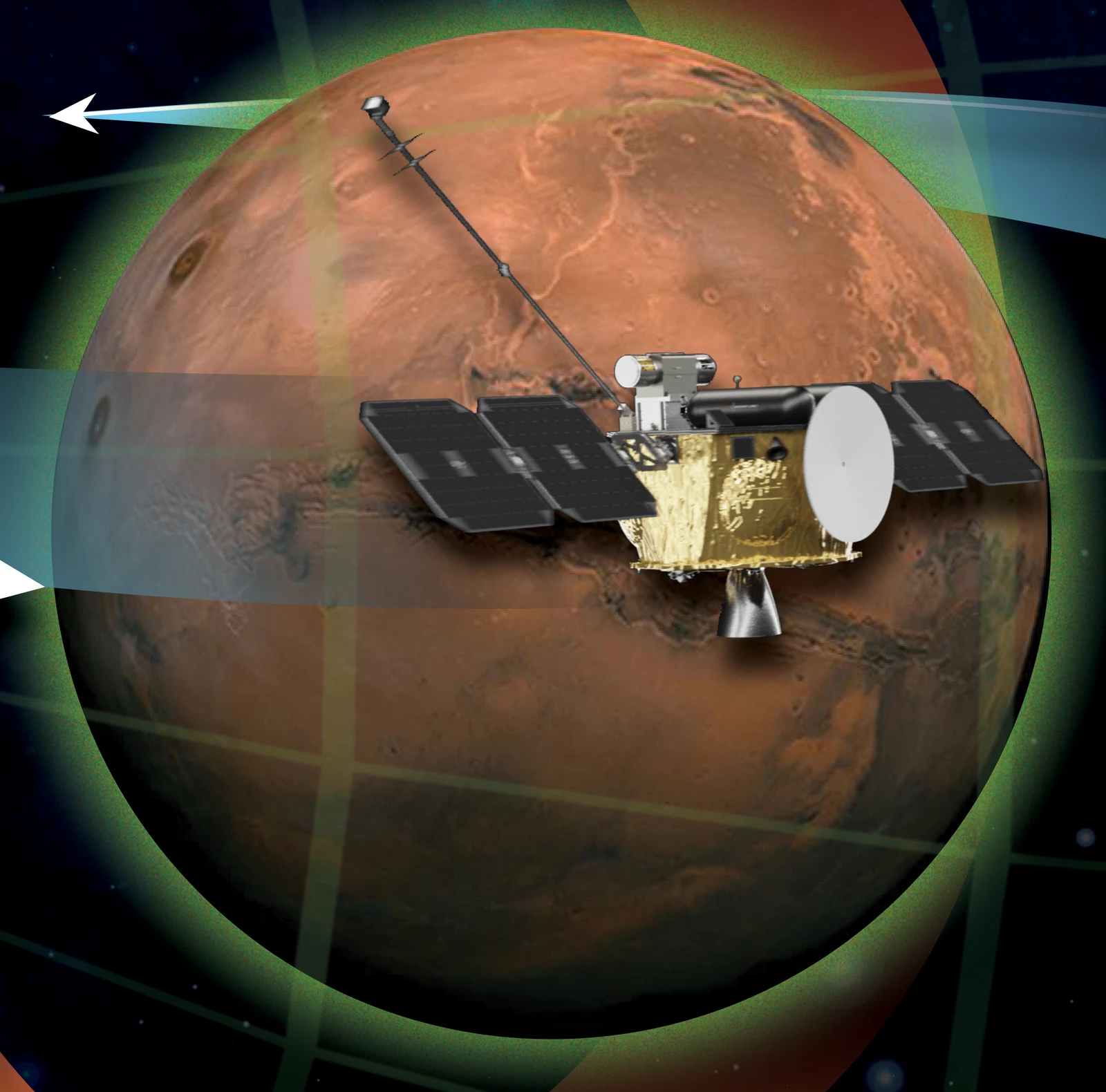 Photo: NASA / Rocket Lab / UC Berkeley / Official ESCAPADE mission concept rendering depicting the spacecraft deployed in Martian orbit.
The Maneuver Architecture: Precision Earth Flybys
To reach Mars efficiently without demanding colossal launch vehicles, ESCAPADE adopted a non-traditional, highly calculated orbital pathway. Launched in late 2025, the probes completed an extended trajectory looping around the Sun-Earth Lagrange Point 2 (L2) region before returning toward Earth’s gravitational sphere of influence.
According to NASA’s mission flight directors, each spacecraft must execute an independent powered gravity-assist maneuver:
- First Earth Flyby (Blue): Scheduled for approximately 10:00 UTC on November 7, 2026.
- Second Earth Flyby (Gold): Scheduled for approximately 11:00 UTC on November 9, 2026.
During each close encounter, the respective spacecraft dips deep into Earth’s gravity well and conducts an orbital engine burn lasting approximately nine minutes. By firing their onboard chemical thrusters precisely at closest planetary approach, the probes exploit the Oberth effect—converting gravitational acceleration into a substantial delta-v velocity boost that propels them outward on an interplanetary trans-Mars injection arc.
Mission Timetable & Flight Milestones
The operational roadmap traces ESCAPADE’s journey from orbital testing through scientific operations in Martian orbit:
| Flight Milestone | Date or Target Window | Mission Status & Technical Detail |
|---|---|---|
| Launch | November 13, 2025 | Completed successfully into heliocentric transfer |
| First Earth Flyby (Blue) | ~10:00 UTC, Nov 7, 2026 | Scheduled powered gravitational slingshot |
| Second Earth Flyby (Gold) | ~11:00 UTC, Nov 9, 2026 | Scheduled trailing flyby and orbital insertion |
| Engine Firing Duration | ~9 minutes per spacecraft | Critical propulsive delta-v burn at perigee |
| Interplanetary Cruise | Nov 2026 – Sept 2027 | ~10-month quiet transit through deep space |
| Mars Orbit Insertion | September 7 & 9, 2027 | Planned entry into highly eccentric elliptical orbits |
Sources: NASA Heliophysics Division and mission flight operations telemetry.
Why Two Probes? The Science of Stereo Measurement
While single orbiters like NASA’s MAVEN and ESA’s Mars Express have provided invaluable data on the Martian upper atmosphere, solitary measurements suffer from an inherent scientific limitation: an orbiter cannot easily distinguish between a change that occurs across time versus one that varies across spatial locations.
By flying two coordinated, instrument-identical spacecraft simultaneously, ESCAPADE overcomes this barrier through simultaneous multi-point observations:
- Upstream Solar Wind Monitoring: While one orbiter flies outside Mars’ bow shock to measure incoming coronal mass ejections and magnetic storms in real time, the second probe flies lower inside the ionosphere to record how the Martian atmosphere reacts.
- String-of-Pearls Formation: During early science phases, the two probes will pass through the same orbital corridor separated by minutes, tracking how plasma structures fluctuate on microsecond scales.
- Escaping Ion Tracing: Each probe carries a miniaturized payload including an electrostatic analyzer, a fluxgate magnetometer, and a Langmuir probe, mapping how ions are energized and stripped away along magnetic cusps.
A New Paradigm for Low-Cost Planetary Science
Beyond its atmospheric science objectives, ESCAPADE is a critical pathfinder for NASA’s SIMPLEx (Small Innovative Missions for Planetary Exploration) program.
With a development budget roughly one-tenth the cost of traditional flagship Discovery-class planetary missions, ESCAPADE demonstrates that off-the-shelf satellite buses—such as Rocket Lab’s modified Explorer spacecraft platform—can survive the harsh radiation, extreme thermal swings, and deep-space communications demands of interplanetary voyages.
If the twin Earth flybys proceed as planned over the coming 48 hours, Blue and Gold will embark on their final 10-month sprint across the solar system, setting the stage for a dramatic dual arrival at the Red Planet in September 2027.
Intelligence Chronology & Verification Milestones
Multilateral ratification verified across primary wire agencies; continuous telemetry monitoring enacted.
Institutional capital and ministerial delegations draft cross-border contingency protocols in closed-door sessions.
Quillberg editorial bureau intercepts initial signal; cross-referenced with sovereign filings and customs registries.
Cite This Dispatch & Link Back
Quoting, analyzing, or covering this story in your publication, academic research, or blog? Use this formatted citation to link back directly to the verified source:
[Quillberg News: NASA Executes Dual Earth Flybys to Catapult Twin ESCAPADE Spacecraft](https://quillberg.com/nasa-escapade-earth-flybys-mars-november-2026)
📰 Related Strategic Intelligence
More in Tech → Tech
ESA Approves Seven-Spacecraft Fleet to Guard Earth's Magnetosphere
 Tech
Voyager 1 Crosses Historic 'One Light-Day' Distance Milestone From Earth
 Tech

